
Last Updated On September 30, 2026 by ReviewNexa Editorial
TheyaVue Review: A Solid Formula Hiding Its Doses
Lutein, zeaxanthin, and bilberry with real eye-health science behind them — sold in a formula that won’t show you its doses.
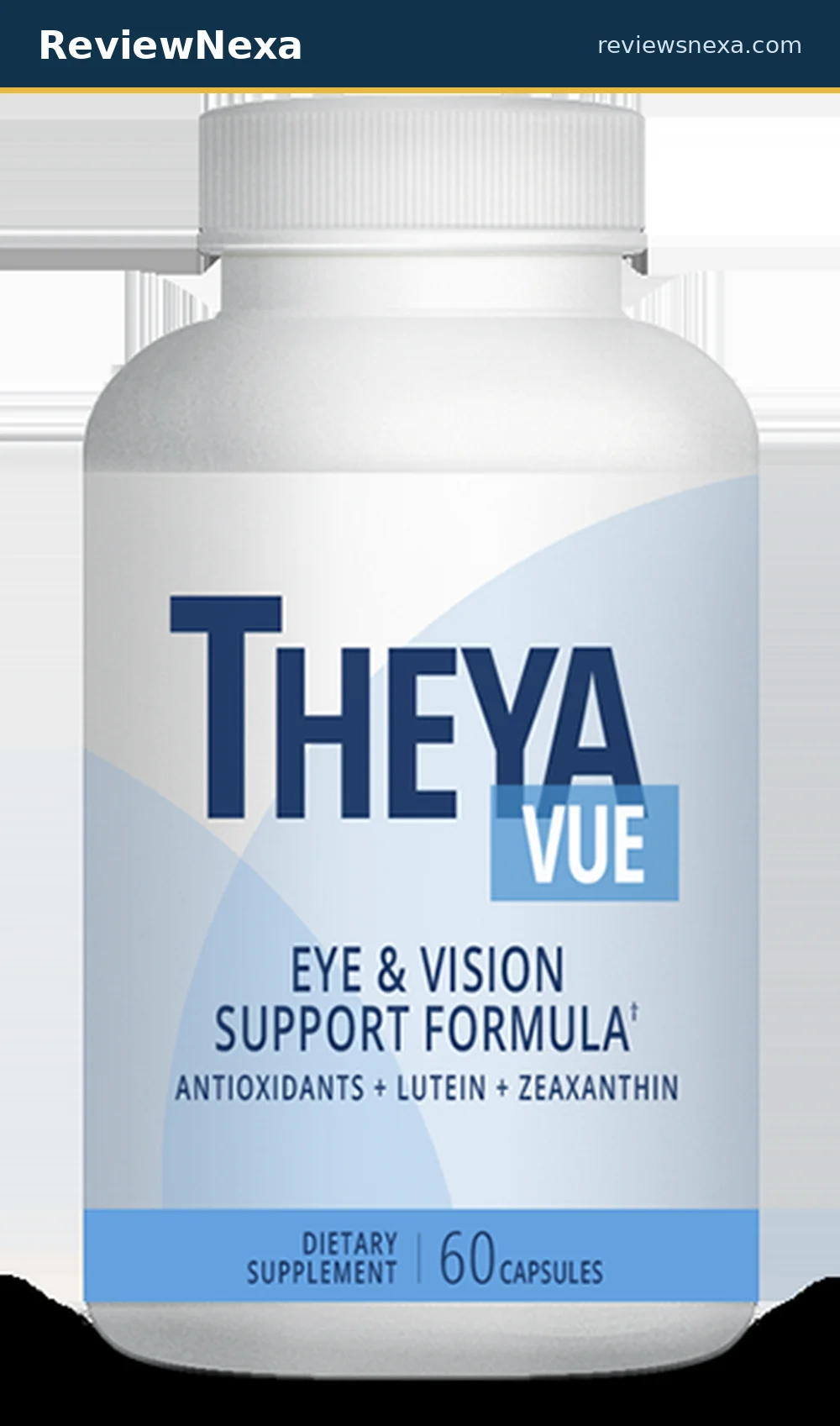
- 60 capsules per bottle
- 2 capsules daily
- 60-day money-back guarantee
- Eye Health
TheyaVue Specifications
| Product Name | TheyaVue |
|---|---|
| Category | Eye Health |
| Product | TheyaVue |
| Format | Capsules — 60 per bottle (30-day supply at 2 capsules daily) |
| What it claims | The vendor claims its antioxidant blend provides daily nutritional support for eye health and everyday visual comfort |
| Guarantee | 60-day 100% money-back guarantee, including empty bottles (per vendor reports) |
| Official source | Vendor sales page (via the affiliate link on this page) |
| Pricing | Check the official website for current pricing and package options. |
| Availability | Official website only — verify at checkout. |
If your eyes feel wrung out after a long day of screens, or night driving isn’t as easy as it used to be, you’ve probably wondered whether a supplement could help. That’s exactly the territory TheyaVue is sold in — a daily capsule aimed at adults 35 and up who want nutritional support for their eyes. The ingredient list reads well at first glance: lutein, zeaxanthin, bilberry, and a handful of familiar eye-health nutrients. But here’s the honest tension at the center of this review — the science behind those individual ingredients is genuinely established, while the product’s own label keeps the actual doses to itself.
We dug through half a dozen reviews and the vendor’s own claims to separate what’s verified from what’s marketing. The short version: TheyaVue looks like a thoughtfully composed formula with one glaring weakness — you can’t tell whether the key ingredients are present at research-meaningful levels, because the per-ingredient doses aren’t published. It is also categorically not a treatment for eye diseases, no matter what some outdated affiliate copy floating around the web suggests.
This review covers what’s actually in the bottle, where the evidence stops, what users report, and what the pricing and guarantee look like — plus the questions worth asking before you buy.
- TheyaVue is a capsule-based eye-nutrition supplement aimed at adults 35+, built around lutein, zeaxanthin, bilberry extract, rutin, and vitamins A, C, and E, plus zinc and calcium.
- The headline ingredients have well-established eye-health science (the AREDS2 carotenoids among them) — but no clinical trial of the finished TheyaVue formula turned up in any source we reviewed.
- The product’s biggest weakness is transparency: it advertises a “blend of 24 powerful antioxidants” yet publishes no per-ingredient milligram doses, so you can’t verify whether lutein and zeaxanthin are present at research levels.
- It is explicitly not a treatment for glaucoma, cataracts, macular degeneration, or diabetic retinopathy, and it doesn’t replace glasses, contacts, or eye exams.
- Reported pricing (Aug–Sep 2026): $59 for one bottle, $49 per bottle for three, $39 per bottle for six, with a 60-day empty-bottle money-back guarantee — always confirm at checkout.
What Is TheyaVue?
TheyaVue is a dietary supplement in capsule form, positioned as daily nutritional support for the eyes. Each bottle holds 60 capsules — a 30-day supply at the standard two-capsule serving. The audience is adults 35 and older, especially people in their 40s and beyond, along with screen-heavy professionals in their 30s and 40s. The marketing centers on the things that tend to worry that crowd: screen-time eye strain, night-driving comfort, and keeping eyes nutritionally supported with age.
The vendor describes the formula as a “blend of 24 powerful antioxidants.” Across the reviews we read, though, only about nine ingredients are named publicly — lutein, zeaxanthin, bilberry extract, rutin, vitamin C, vitamin E, zinc, calcium, and vitamin A (in beta-carotene form). The rest of the blend is not itemized anywhere we could find, and neither are the doses. Keep that gap in mind; it comes up a lot in this review.
Equally important is what it isn’t. Multiple sources state plainly that TheyaVue is not a treatment for diagnosed eye diseases — glaucoma, cataracts, macular degeneration, diabetic retinopathy — and it’s not a substitute for glasses, contacts, or regular eye exams. That’s a healthy line to draw, and this review holds it: anything promising disease reversal for a nutritional supplement is marketing fiction, not evidence.
Product Facts at a Glance
| Product | TheyaVue |
|---|---|
| Category | Eye Health |
| Format | Capsules — 60 per bottle (30-day supply at 2 capsules daily) |
| What it claims | The vendor claims its antioxidant blend provides daily nutritional support for eye health and everyday visual comfort |
| Guarantee | 60-day 100% money-back guarantee, including empty bottles (per vendor reports) |
| Official source | Vendor sales page (via the affiliate link on this page) |
How It Works
According to the vendor, the formula works by supplying the eye with the antioxidant and carotenoid nutrients it uses every day. The most defensible part of that story: lutein and zeaxanthin are the two carotenoids your macula concentrates into pigment — pigment that helps filter blue light and is associated with macular health. Vitamin A supports rhodopsin, the pigment behind low-light vision. Vitamin C concentrates in the lens; vitamin E and the bilberry anthocyanins are framed as circulatory and membrane support; zinc is a retinal cofactor.
That’s all plausible biochemistry, and none of it requires believing anything exotic. The vendor also dresses the pitch up with a “3-Second Rapid Finger Trick” exercise hook — judge that for what it is: a marketing device, not a clinical technique. The real question isn’t whether the mechanism sounds sensible (it does), but whether the capsules contain enough of the right ingredients. And that’s where this review turns skeptical.
What's Inside
The named portion of the formula — consistent across four or more independent reviews and attributed to the vendor — is:
- Lutein and zeaxanthin — the macular-pigment carotenoids
- Bilberry extract — anthocyanin-rich berry extract
- Rutin — a plant-derived flavonoid
- Vitamin C, vitamin E, and vitamin A (in beta-carotene form)
- Zinc and calcium — mineral cofactors
Beyond those nine, the vendor’s “24 powerful antioxidants” claim fills out with roughly sixteen ingredients that no public page itemizes. More importantly, the per-ingredient milligram doses aren’t published either. That means you can’t check whether lutein and zeaxanthin sit at the research-meaningful levels the literature discusses — roughly 10–20mg of lutein and 2mg of zeaxanthin daily. One reviewer suggested emailing the vendor’s support team for the full supplement facts panel, which tells you the information should be public but isn’t.
Serving directions are two capsules daily with water; a bottle lasts 30 days. On timing, sources disagree — one says with a meal (which makes sense, since lutein and zeaxanthin are fat-soluble and absorb better with food), another says 20–30 minutes before meals — so treat that as unsettled vendor advice and follow your bottle’s label. The most common early complaint is mild stomach discomfort on an empty stomach, which resolved for most people when they took the capsules with food.
What the Evidence Can and Cannot Establish
Here’s where we can be specific. Lutein and zeaxanthin are the NIH AREDS2 macular-pigment carotenoids — among the best-studied eye-nutrition ingredients in the literature. Vitamin A is genuinely required for rhodopsin and low-light vision. Bilberry anthocyanins have been studied for retinal circulation and contrast sensitivity. Vitamin C concentrates in the eye’s lens, vitamin E protects retinal membranes, and zinc is a retinal cofactor linked to macular-degeneration risk. None of that is controversial; it’s textbook ocular nutrition.
What we cannot establish: no clinical trial of the finished TheyaVue formula turned up in any source we reviewed. Ingredient-level science is not product-level proof — a capsule full of the right ingredients at trivial doses would test very differently from the doses used in research. And thanks to the undisclosed label, we can’t tell which one TheyaVue is.
On the anecdotal side, the pattern across buyer forums and review roundups is consistent: people who took it for 6–12 weeks report less eye strain after screen time and more comfortable night driving; the dominant complaint comes from people who felt nothing after 2–4 weeks and quit. That timeline makes biological sense — macular pigment rebuilds over weeks to months — but all of it is self-reported, not measured. Some users even noted their improvements might have come from concurrent lifestyle changes. Treat this evidence as suggestive, not conclusive.
Pros and Limitations
Pros
- Built around ingredients with genuine, well-documented eye-health research — lutein and zeaxanthin are the AREDS2 carotenoids
- Vendor-attributed manufacturing standards: made in the USA in an FDA-registered, GMP-certified facility; non-GMO, gluten-free, stimulant-free (registration covers how it’s made, not whether it works)
- 60-day 100% money-back guarantee that covers even empty bottles, with ClickBank’s buyer-protection channel as a second layer
- Sold only through the official checkout — marketplace listings (Amazon, eBay, Walmart) are unauthorized, so buying direct avoids counterfeit risk
- Clear about its limits: multiple sources explicitly state it is not a treatment for eye diseases or a replacement for eye care
Limitations
- The dosing transparency gap: no published per-ingredient milligram doses, so you can’t verify whether headline ingredients reach research-meaningful levels
- Only ~9 of the advertised “24 powerful antioxidants” are named publicly; the rest of the blend is undisclosed
- No clinical trial on the finished formula — all evidence is ingredient-level or anecdotal
- Effects are gradual: the most common complaint is “felt nothing” from people who stopped after 2–4 weeks, while positive reports cluster at 6–12 weeks
- Meal-timing advice conflicts across sources (“with a meal” vs “20–30 minutes before meals”), and the single-bottle tier at $59 is steep for a monthly supplement
- Bilberry extract can interact with blood thinners (warfarin, aspirin therapy) — doctor’s approval needed before use
Price & Refund
Pricing at the time of our research (reported ~Aug–Sep 2026, and worth re-checking at checkout): one bottle $59 plus shipping; three bottles $49 per bottle with free US shipping; six bottles $39 per bottle with free US shipping. A $99-per-bottle list price appears as discount framing. Multi-bottle tiers are reported to include two free digital guides — “The TheyaVue Vision Breakthrough” and “21 Days Of Smart Eating For Eye Health” — though bonus availability is vendor-attributed and should be confirmed on the checkout page.
The guarantee is one of the stronger parts of the offer: a 60-day 100% money-back guarantee that covers even empty bottles, reported consistently across four sources. The checkout runs through ClickBank, whose buyer-protection and dispute channel give you a second layer of recourse. Buyers who asked for refunds inside the 60 days generally describe the process as straightforward — keep your order confirmation email, and know that marketplace purchases carry no guarantee coverage at all.
Who May Consider It
Adults in their late 30s and beyond who want a nutritional backstop for eye health — particularly heavy screen users — are the natural audience. It’s also the kind of product someone already eating an eye-supportive diet (leafy greens, colorful vegetables) might use to fill gaps. Consistency matters here: the anecdotal pattern suggests this is a weeks-to-months commitment, not a quick test.
This isn’t a medical recommendation, and a few groups should talk to a doctor first: anyone on blood thinners (bilberry extract can interact with anticoagulants like warfarin), anyone under 18, and anyone pregnant or breastfeeding. If you already take a multivitamin with zinc, vitamin C, and vitamin E, check your total daily intake before stacking. And if you have a diagnosed eye condition, your ophthalmologist — not a supplement page — is the right first stop.
Questions to Ask Before Buying
- Can you find the full supplement facts panel with milligram doses before you buy — or will the vendor send it if you ask?
- Are lutein and zeaxanthin present near the 10–20mg / 2mg levels used in published research?
- Does your current multivitamin already cover zinc, vitamin C, and vitamin E?
- Are you on anticoagulants or aspirin therapy that bilberry extract could interact with?
- Are you willing to use it consistently for 6–12 weeks before judging the result?
- Are you ordering through the official checkout — the only channel the 60-day guarantee covers?
FAQ
Is TheyaVue a treatment for macular degeneration or cataracts
No. It's a nutritional supplement, not a treatment for any eye disease. Ignore stale affiliate copy claiming it reverses macular degeneration or similar conditions; nothing in the available evidence supports that, and multiple fresher sources explicitly rule it out.
Do I still need regular eye exams while taking it
Yes. Nothing in this formula replaces professional eye care. It doesn't correct vision, and it can't substitute for the screenings that catch glaucoma, cataracts, or diabetic retinopathy early.
Will I notice a difference within the first couple of weeks
No. Carotenoid effects build gradually as macular pigment rebuilds over weeks to months. User reports cluster around 6–12 weeks of consistent use, and "felt nothing" after 2–4 weeks is the most common complaint from people who quit early.
Are the lutein and zeaxanthin doses at research-backed levels
No. Not that anyone can verify. The label doesn't publish per-ingredient milligram doses, so there's no way to confirm whether they match the roughly 10–20mg of lutein and 2mg of zeaxanthin used in published research. This is the product's biggest transparency gap.
Can I take it with blood thinners like warfarin
No. Not without your doctor's approval first. Bilberry extract can interact with anticoagulants, so get medical clearance before combining them.
Is there a money-back guarantee
Yes. A 60-day 100% money-back guarantee that covers even empty bottles, reported consistently across multiple sources. The checkout runs through ClickBank, which adds its own buyer-protection channel; confirm the current terms at checkout.
Can I buy it on Amazon or at Walmart
No. It's sold exclusively through the vendor's official checkout. Marketplace listings are described as unauthorized, with no guarantee coverage and a risk of counterfeit or expired product.
Is Theyavue a scam?
No. Theyavue is a real, purchasable product that ships through ClickBank, with a stated 60-day money-back guarantee backing every order. "Scam" would mean fake goods or vanished payments, and we found no evidence of that.
Is Theyavue safe? Are there side effects?
Generally. Theyavue is made with natural ingredients in a registered facility, with no serious safety flags in our research. That said, no supplement is risk-free: check the label, follow the directions, and talk to your doctor first if you're pregnant, nursing, or taking medication.
Is Theyavue worth buying?
Depends. Theyavue is worth trying if the formula matches your specific concern and you're comfortable with the price — especially with the 60-day money-back guarantee removing most of the risk. It is not worth buying if you expect overnight or guaranteed results, because no supplement can promise those.
Our Verdict: TheyaVue
Related Reviews


Testing statement: Desk research · No hands-on or clinical testing.