
Last Updated On September 30, 2026 by ReviewNexa Editorial
Vision 20 Review: Zenith Labs’ Eye Formula, Honestly Assessed
Vision 20 is Zenith Labs’ lutein-and-zeaxanthin eye supplement promising clearer, more comfortable vision — we dug into the formula, the ingredient science, buyer feedback, and the guarantee so you can judge it on facts, not sales copy.
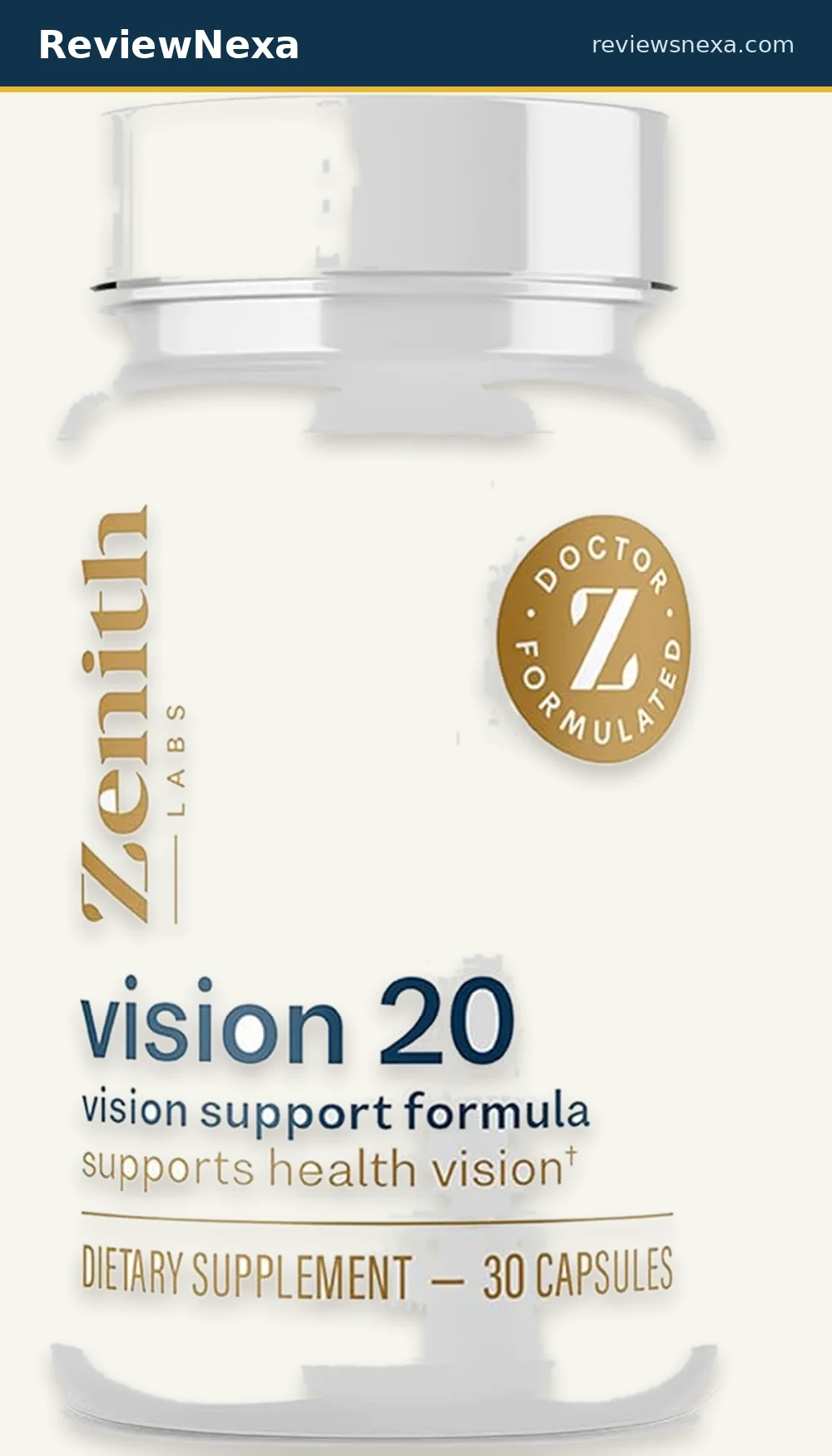
- By Zenith Labs
- Lutein + zeaxanthin core
- Once-daily capsule
- 180-day guarantee (reported)
Vision 20 Specifications
| Product Name | Vision 20 |
|---|---|
| Category | Eye Health |
| Product | Vision 20 |
| Format | Capsules — one month’s supply per bottle (reported) |
| What it claims | "the vendor positions it as daily nutrition for macular pigment, blue-light filtering, and visual comfort" |
| Guarantee | 180-day money-back guarantee (reported — confirm exact terms at checkout) |
| Official source | Vendor sales page (via the affiliate link on this page) |
| Pricing | Check the official website for current pricing and package options. |
| Availability | Official website only — verify at checkout. |
By the time most of us hit our forties, the signs are annoyingly familiar: menu text that swims at arm’s length, eyes that feel sandpapery after a long day of screens, and headlights that bloom into starbursts on the evening drive. Vision 20 is Zenith Labs’ answer to that creeping unease — a daily capsule built around the two carotenoids your macula actually uses, lutein and zeaxanthin, wrapped in a broader blend of antioxidants and circulation botanicals.
This review isn’t here to sell you the bottle. We read the vendor’s materials, third-party reviews, the ingredient science, and the buyer-feedback patterns, then weighed what holds up and what doesn’t.
The short version, up front: the formula’s core rests on genuinely well-studied nutrition science, while the marketing around it sometimes runs bigger than the evidence. Everything here comes from desk research — vendor materials, independent reviews, and published ingredient science — and we didn’t test the product hands-on. The line below says that formally.
- Vision 20 is a ten-ingredient eye-health capsule from Zenith Labs (the Dr. Ryan Shelton company), centered on lutein and zeaxanthin — the carotenoids that concentrate in your macula.
- The carotenoid core is genuinely well-studied: the NEI’s AREDS2 trial used lutein/zeaxanthin in its eye-vitamin protocol, and higher macular pigment is linked to better glare recovery and contrast sensitivity.
- No clinical trial exists on this exact commercial blend — ingredient-level research is real, but it doesn’t automatically prove what the finished product does for you.
- It can’t fix refractive errors, cataracts, glaucoma, or AMD, and any comfort gains typically need 60–90 days of daily use — not a weekend.
- Reported pricing: $59 / $147 / $234 for 1 / 3 / 6 bottles with a 180-day guarantee. Buy only through the official offer page — the counterfeit complaints trace back to third-party sellers.
What Is Vision 20?
Vision 20 is a daily eye-health supplement from Zenith Labs, the supplement company founded by Dr. Ryan Shelton, aimed squarely at adults who feel their vision getting less reliable with age. Each bottle holds a month’s supply of capsules built on a simple premise: your macula — the small central patch of retina behind sharp, detailed sight — runs on lutein and zeaxanthin, two carotenoids your body can’t manufacture on its own.
The idea underneath is less exotic than the sales page makes it sound. Macular pigment absorbs short-wavelength blue light before it reaches your photoreceptors — nutrition researchers sometimes call this “internal sunglasses” — and it also helps quench the oxidative stress that comes with light exposure and everyday metabolism. Since your body can’t synthesize these pigments, food (leafy greens, eggs, corn) or a supplement is the only way to top them up.
Around that core sits the supporting cast you’d expect from someone who actually read the eye-nutrition literature: zinc, beta-carotene and vitamin A, bilberry, taurine, grape seed extract, lycopene, and rose hips. One capsule a day is the reported serving, and the label discloses its ingredients individually instead of burying them in a proprietary blend — a small detail that counts for more than it sounds like.
Product Facts at a Glance
| Product | Vision 20 |
|---|---|
| Category | Eye Health |
| Format | Capsules — one month’s supply per bottle (reported) |
| What it claims | “the vendor positions it as daily nutrition for macular pigment, blue-light filtering, and visual comfort” |
| Guarantee | 180-day money-back guarantee (reported — confirm exact terms at checkout) |
| Official source | Vendor sales page (via the affiliate link on this page) |
How It Works
According to Zenith Labs, the formula works on three fronts. First, lutein and zeaxanthin accumulate in macular pigment, where they absorb blue light before it reaches the photoreceptors. Second, the antioxidant ingredients — lycopene, grape seed, rose hips, beta-carotene — are there to neutralize the free radicals generated by light exposure and normal metabolism. Third, circulation-oriented botanicals like bilberry, plus the amino acid taurine, are included to support blood flow through the eye’s tiny vessels, which is a sensible target given how metabolically demanding retinal tissue is.
That’s the vendor’s story, and it’s a plausible one — but it belongs in the “mechanism” column, not the “proof” column. Some of the marketing leans on language about “ROS toxins” and a “toxic protein” accumulating in the macula. There’s no recognized “toxic protein” diagnosis in ophthalmology; that’s sales-page shorthand for age-related macular waste and oxidative damage. The nutritional logic underneath still holds — the terminology just isn’t medical.
What's Inside
The label discloses its ingredients individually — no proprietary blend, which is genuinely a point in the product’s favor. The September 2026 company materials list ten: lutein, zeaxanthin, zinc, beta-carotene, lycopene, rose hips extract, vitamin A (retinyl palmitate), taurine, grape seed extract, and bilberry extract. Older third-party write-ups mention LuteMax2020 (a branded lutein/zeaxanthin form, reported at 20 mg), zinc citrate, and rutin — so the roster may have shifted over time, or reviewers may have paraphrased loosely. Either way, your bottle’s Supplement Facts panel is the document of record, not this article. Below is what each headline ingredient is actually known for, with doses as reported by review sources.
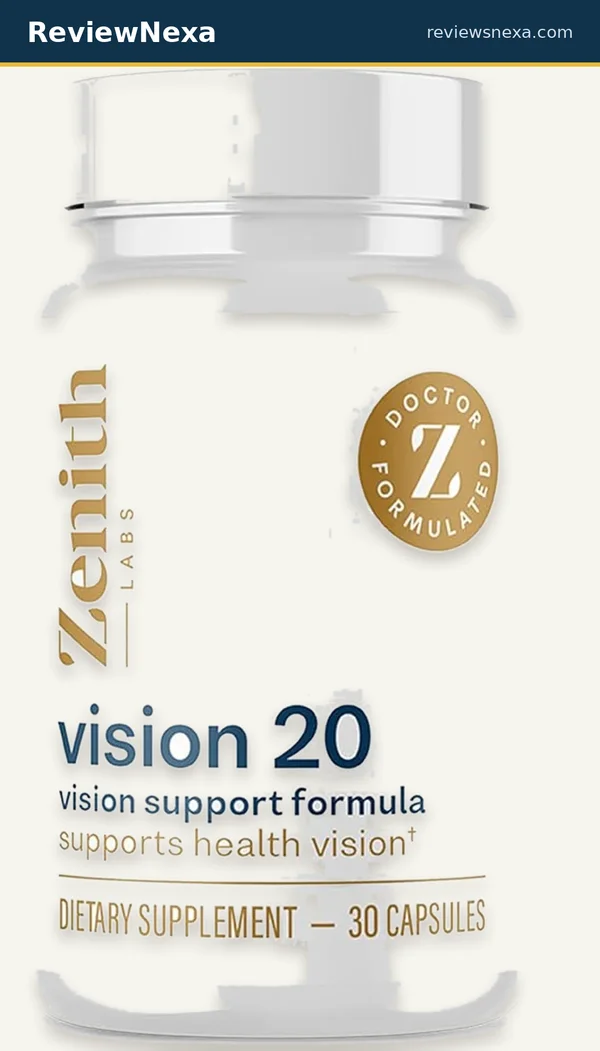
A closer look at the Vision 20 bottle — official product photo.
A few honest notes on the standouts:
- Lutein + zeaxanthin (LuteMax2020, 20 mg reported): the best-studied eye nutrients in nutrition science. The NEI’s AREDS2 trial included them in its eye-vitamin protocol, and multiple studies link higher macular pigment density to better glare recovery and contrast sensitivity.
- Zinc: concentrated in the retina and involved in night-vision chemistry; citrate is a well-absorbed form.
- Beta-carotene / vitamin A: vitamin A is essential for photoreceptor function. One caution worth knowing: high-dose beta-carotene has a documented risk signal in current and former heavy smokers (the ATBC/CARET trials). Vision 20’s dose is modest, but smokers should still mention it to their doctor.
- Bilberry: rich in anthocyanins; small human trials suggest help with night-vision adaptation and eye fatigue, probably through circulation and antioxidant effects.
- Taurine: an amino acid highly concentrated in the retina; protective in animal and cell studies, thin on human eye-specific data.
- Grape seed, rutin, lycopene, rose hips: general antioxidant and capillary support — a sensible backup cast rather than the main event.
What the Evidence Can and Cannot Establish
Here’s the honest accounting. The ingredient-level science is genuinely decent — few supplement categories have a large public trial like AREDS2 sitting behind their core nutrients, and the link between macular pigment density and glare recovery/contrast sensitivity shows up across multiple studies. But no published clinical trial exists on this exact ten-ingredient commercial blend. The studies were run on individual nutrients or research blends, at specific doses, and there’s no guarantee the capsule matches them.
There’s a second wrinkle worth flagging. Review-source ingredient lists don’t fully agree: some name LuteMax2020 and zinc citrate, the September 2026 company materials list a ten-ingredient roster including retinyl palmitate, and older reviews add extras like astaxanthin, ginkgo, copper, and maritime pine. The formula may have been revised, or reviewers may have been loose with details. We’ve marked it uncertain because inventing certainty here would be worse than admitting the gap.
So the evidence supports the ingredients’ plausibility as eye nutrition — not the finished product’s efficacy. That’s true of nearly every eye supplement on the market, but it’s the sentence most reviews won’t write.
Pros and Limitations
Pros
- A genuinely well-chosen carotenoid core — lutein and zeaxanthin are among the best-supported nutrients in eye nutrition.
- Ingredients disclosed individually on the label — no proprietary blend hiding the formula.
- Simple once-daily routine; non-GMO and gluten-free (reported); made in a regularly audited US facility (reported).
Limitations
- No clinical trial on the finished Vision 20 formula itself.
- Realistic benefits need 60–90 days of daily use; nothing meaningful changes in a week.
- Can’t correct myopia, astigmatism, cataracts, or glaucoma — and isn’t a treatment for diagnosed eye disease.
Price & Refund
The offer page sells the standard three-tier structure: one bottle for $59, three bottles at $49 each ($147 total), and six bottles at $39 each ($234 total) — with bonuses on the multi-bottle tiers and free shipping on the six-bottle package. All of that is as reported at research time, and all tiers carry the reported 180-day money-back guarantee. Treat every number here as “as of the date we checked,” because direct-sale pricing moves with promotions — the checkout page is the price of record.
One practical read on package size: since macular pigment builds over two to three months, a single bottle is really a trial rather than a full test. But don’t let bundle math push you past your comfort level — the guarantee exists precisely so a smaller first order stays low-risk.
Who May Consider It
Adults over 40 with screen-heavy days who want a carotenoid-based daily eye-nutrition habit. People bothered by night-driving glare — after an eye exam has ruled out cataracts or an outdated prescription as the cause. And proactive buyers with a family history of macular degeneration who want these nutrients as part of a broader eye-care routine, alongside regular exams rather than instead of them. This isn’t a medical recommendation, and it isn’t for diagnosed eye disease: if an ophthalmologist has put you on an AREDS2 formula, that’s a clinical-grade protocol in a different lane from this supplement.
Questions to Ask Before Buying
- What does my bottle’s Supplement Facts panel actually list — and does it match what I read online?
- Have I had a recent eye exam to rule out treatable causes of my symptoms, like cataracts, glaucoma, or a prescription change?
- Am I already taking a multivitamin or an AREDS2 formula that would overlap with these ingredients?
- Do the checkout page’s guarantee terms — window length, return process, who pays return shipping — match what’s advertised?
FAQ
Will Vision 20 improve my eyesight?
No. Not in the way most people hope. It won’t change your glasses prescription or sharpen your distance vision, because nutrition can’t alter your eye’s optics. What it can plausibly do over 60–90 days is support macular pigment density, which studies link to better contrast sensitivity, glare recovery, and visual comfort — the difference between “I read fine” and “I read fine without my eyes aching by evening.”
Is Vision 20 safe to take?
Yes. At the reported serving, these are food-derived nutrients in studied ranges, and review sources report no significant side-effect pattern. The honest caveats: take capsules with food (empty-stomach queasiness is the most reported complaint), smokers should flag the beta-carotene to their doctor, and anyone on blood thinners or an existing AREDS2 formula should check with a clinician before stacking.
Do I need to take it for months before judging it?
Yes. And this is where most disappointment comes from. Macular pigment accumulates slowly, so eye-strain comfort may shift within the first month, but the contrast and glare benefits the formula is built around typically need two to three months of daily use. Judging it at week three misses the design entirely.
Can I buy Vision 20 on Amazon or in stores?
No. It’s sold through the official offer page only, and that’s deliberate. The counterfeit complaints we found trace back to third-party marketplaces: wrong-looking capsules, orders that never arrived, and guarantee eligibility that doesn’t exist outside the official channel. If the price somewhere else looks better, that’s a red flag, not a deal.
Is the 180-day guarantee real?
Yes. As reported across the vendor’s materials and multiple review sources, orders carry a 180-day money-back guarantee. That said, guarantee terms can change and the fine print matters: read the window length, the return process, and who pays return shipping on the checkout page itself, and keep your order confirmation.
I’m already on an AREDS2 formula — should I switch?
No. Don’t swap a doctor-recommended protocol for a general supplement on your own. AREDS2 is a clinical-grade formula for diagnosed macular degeneration; Vision 20 is daily prevention-and-comfort nutrition. They’re different lanes. If you’re curious about overlap, show both labels to your ophthalmologist.
Is Vision 20 a scam?
No. Nothing about it matches an actual scam profile: a real company in Zenith Labs, a real shipped product, individually disclosed ingredients, and a long guarantee window. The legitimate criticisms are about overenthusiastic marketing and slow, modest results — reasons to calibrate expectations, not to call it fraud.
Is Vision 20 worth buying?
Depends. Vision 20 is worth trying if the formula matches your specific concern and you're comfortable with the price — especially with the 180-day money-back guarantee removing most of the risk. It is not worth buying if you expect overnight or guaranteed results, because no supplement can promise those.
Our Verdict: Vision 20
Related Reviews



Testing statement: Desk research · No hands-on or clinical testing.