
Last Updated On September 30, 2026 by ReviewNexa Editorial
Neuro-Thrive Review: The Label Photo and the Marketing Tell Different Stories
This brain-health capsule promises memory and focus support, but the ingredient lists on review sites openly contradict each other — so this review leans on the one piece of hard evidence we could find.
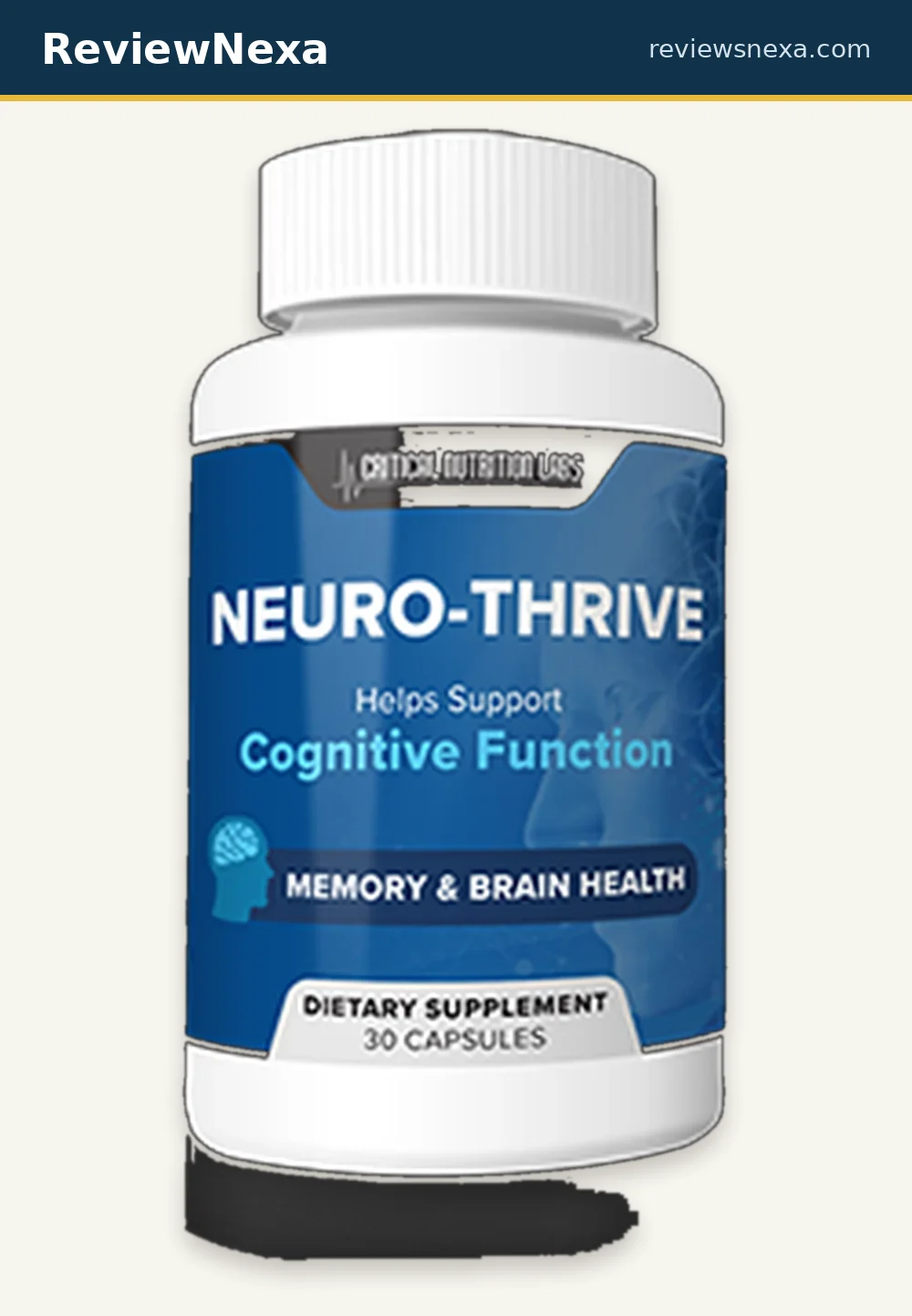
- Capsules · ~$69 / bottle
- 60-day guarantee reported
- Caffeine-free
- Ingredient lists vary by source
Neuro-Thrive Specifications
| Product Name | Neuro-Thrive |
|---|---|
| Category | Mind & Brain |
| Product | Neuro-Thrive |
| Format | 30 capsules per bottle (veggie capsules, per one review source) |
| What it claims | Supports memory, focus, mental clarity, and brain-fog relief; stimulant-free and caffeine-free (vendor-attributed marketing claims) |
| Guarantee | 60-day money-back guarantee consistently reported across sources; exact refund mechanics to be confirmed on the checkout page |
| Official source | Vendor sales page (via the affiliate link on this page) |
| Pricing | Check the official website for current pricing and package options. |
| Availability | Official website only — verify at checkout. |
Neuro-Thrive is one of those supplements where the first thing you notice, if you actually look, is how little agreement there is about what’s in the bottle. One review site lists Bacopa, Alpha GPC, GABA, and PQQ. Another lists Ginkgo, Lion’s Mane, Rhodiola, and L-Theanine. Both claim to describe the same product. They can’t both be right, and that contradiction is exactly why this review exists.
Here’s what we did instead of picking a side: we tracked down the one source in our research that published an actual photo of the supplement-facts label, and treated it as the controlling evidence. We also dug into the marketing’s loftier claims — the Harvard name-drops, the dose figures on the cited studies, a “doctor” persona — and checked what actually backs them up. The result is a review that reads a little differently from the cheerful ones everywhere else. That’s deliberate. You’re about to spend real money; you deserve the honest version first.
- Neuro-Thrive is a capsule supplement for everyday memory, focus, and mental clarity — a wellness product, not a drug or a dementia treatment.
- Review sites can’t agree on what’s in it. One label photo shows Bacopa, Alpha GPC, GABA, PQQ, B6, niacin, and D3; several affiliate reviews list a completely different herb-based formula. The label photo wins.
- That same label photo shows a vitamin B6 figure of 300 mg — about three times the adult tolerable upper intake level — which is unusual enough to verify on your own bottle before buying.
- Marketing references to Harvard and medical journals have no evidenced connection to this product, per an independent investigator’s findings. Claims like that should never go unquestioned.
- Pricing reported in 2026 coverage runs $69 for one bottle down to $49 per bottle in the 6-pack, with a 60-day money-back guarantee consistently reported — always confirm at checkout.
What Is Neuro-Thrive?
Neuro-Thrive is a dietary supplement in capsule form, sold for brain and cognitive wellness — memory, focus, mental clarity, the usual suspects. The marketing aims squarely at adults dealing with everyday forgetfulness: the misplaced keys, the name that won’t surface, the mid-afternoon fog. It’s positioned as a stimulant-free, caffeine-free daily routine, and one bottle holds 30 capsules.
The sales story leans hard on a narrative about a “Japanese memory bean” — essentially natto, the fermented soybeans — presented as the inspiration behind the formula. Strip away the theater and it’s a standard supplement story arc: an interesting food anecdote dressed up to imply the capsule carries some version of that benefit. There is no clinical evidence connecting the story to the product in the bottle. It also isn’t a treatment for dementia or Alzheimer’s, no matter how closely the marketing walks up to implying otherwise. That’s an important line, and the marketing walks right up to it.
One thing worth knowing up front: the vendor sells it directly through its own website. A few review sites warn about counterfeit lookalikes on marketplaces like Amazon — but that claim traces back to a single affiliate page, so treat it as vendor marketing caution rather than established fact.
Product Facts at a Glance
| Product | Neuro-Thrive |
|---|---|
| Category | Mind & Brain |
| Format | 30 capsules per bottle (veggie capsules, per one review source) |
| What it claims | Supports memory, focus, mental clarity, and brain-fog relief; stimulant-free and caffeine-free (vendor-attributed marketing claims) |
| Guarantee | 60-day money-back guarantee consistently reported across sources; exact refund mechanics to be confirmed on the checkout page |
| Official source | Vendor sales page (via the affiliate link on this page) |
How It Works
According to the vendor’s narrative, Neuro-Thrive works by combining ingredients said to support “mitochondrial health” and “neurogenesis” — the growth of new brain cells. The story traces everything back to that fermented-soybean inspiration: the idea that something in the Japanese memory-bean tradition points toward nutrients that support the brain, and that this capsule concentrates that idea.
Let’s be straight about this. None of that is demonstrated for the finished product. There is no published clinical trial of the Neuro-Thrive formula itself. The entire mechanism argument rests on ingredient-level research plus marketing narrative. The honest reading is that “how it works” here is a story the vendor tells, not a mechanism anyone has shown to work in this specific capsule. We’ll get to what the ingredient evidence actually says in a moment.
What's Inside
This section needs a warning label of its own: the internet cannot agree on Neuro-Thrive’s ingredients. One review site (inmybowl) published an actual photo of the supplement-facts panel, showing: Vitamin D3 20 mcg, Niacin 8 mg, Bacopa Monnieri extract standardized to 50% bacosides, Vitamin B6 300 mg (as pyridoxine HCl — more on this below), Alpha GPC 150 mg, GABA 100 mg, and PQQ 10 mg as the disodium salt.
Meanwhile, three other review sites describe a completely different formula — Ginkgo Biloba, Lion’s Mane, Rhodiola, Phosphatidylserine, L-Theanine, and B12 — with no overlap at all. Either the formula changed dramatically over time, or a lot of affiliate coverage is recycled, sloppy, or written about the wrong product. We can’t settle that from here. What we can do is tell you that the label photo is the only evidence in our research tied to an actual bottle, and that’s the panel we treated as authoritative.
About that B6 figure: one review page’s label photo reads 300 mg of vitamin B6 — an unusually high amount, roughly three times the adult tolerable upper intake level of 100 mg. That could be a label error, a transcription mistake by the review page, or a genuine (and concerning) formulation choice. We’re not going to assert it as settled fact, because it shouldn’t be stated as one. If you’re considering this product, verify the actual B6 amount on the checkout page and on your own bottle, and know that sustained high-dose B6 intake can, over time, cause peripheral nerve symptoms. That’s a conditional caution, not a diagnosis — but it’s one you shouldn’t have to learn from a footnote.
On dosage, sources split again: some report one capsule daily with a meal, others say two. Given the contradictions everywhere else, the bottle label is the only authority worth citing — not us, and not the review sites.
What the Evidence Can and Cannot Establish
What can be established: individual ingredients in the label-photo formula have genuine research behind them. Bacopa Monnieri has a real evidence base for memory in adults. Alpha GPC and PQQ appear in published studies — one PQQ study reported improved composite and verbal memory in adults over 50 after 12 weeks, and Alpha GPC studies have run in older adults too. But here’s the part marketing glosses over: that PQQ study used 20 mg daily — double the 10 mg on this label — and Alpha GPC research typically used 300–600 mg against the label’s 150 mg. “Contains an ingredient that was studied” is not the same as “shown to work at this dose in this product.” That distinction matters more than most reviews admit.
What cannot be established: that this specific formula does anything at all. No published trial of Neuro-Thrive itself turned up in our research. And the marketing’s credibility markers don’t survive contact with evidence either — an independent investigator found no real connection between the product and the Harvard, Harvard Medical School, or Journal of Nutrition references in its sales materials, and no verified endorsements from any doctors, celebrities, hospitals, or universities. The “doctor” imagery traces to stock photography. Meanwhile, the star ratings floating around (4.9, 4.95, 5 out of 5) contradict each other across pages and none were verifiable on any independent platform. We didn’t repeat them as facts because they aren’t facts.
Pros and Limitations
Pros
- The label-photo formula includes genuinely researched ingredients (Bacopa, Alpha GPC, PQQ) rather than pure filler
- Stimulant-free and caffeine-free, so no jitters or sleep disruption from that angle
- 60-day money-back guarantee is consistently reported across every source, giving buyers a reasonable exit window
- Simple capsule format with a straightforward reported routine — no complicated dosing rituals
Limitations
- Ingredient lists across review sites openly contradict each other — buyers can’t be sure of the formula from public coverage alone
- The label photo’s 300 mg B6 figure is implausibly high and must be verified on the actual bottle
- No clinical trial of the finished formula exists; study doses cited for ingredients exceed what’s on the label
- Marketing uses unverified institutional name-drops (Harvard, medical journals) with no evidenced connection
- Refund mechanics vary by source — shipping exclusions and return requirements need confirming at checkout
Price & Refund
As reported in 2026 coverage: one bottle runs $69 plus $7.99 shipping; three bottles come to $177 ($59 per bottle) with free shipping; six bottles come to $294 ($49 per bottle), also with free shipping. One site frames single-bottle pricing as a discount from a $79 regular price. Three- and 6-bottle packs were reported to include free bonus guides — named in one search snippet as “The Neuro Thrive Cookbook” and “The Brain Boosting Guide,” though we only saw that attribution once, so consider it unconfirmed.
The 60-day money-back guarantee is the one thing every source agrees on, and it also appears on the vendor’s own page. The fine print differs between sources — one says shipping costs are excluded, another says bottles must be returned in original condition — so treat “60-day window” as reliable and everything procedural as confirm-at-checkout. One review page lists a per-bottle “$49 (check latest price)” figure; that’s the 6-pack unit price, not the single-bottle price, so don’t let that confuse you at the cart.
Who May Consider It
Honestly? The person who should consider Neuro-Thrive is someone who’s comfortable doing homework. Someone who’ll verify the label on their own bottle, compare the B6 figure we flagged, read the guarantee terms at checkout, and go in understanding that the evidence is ingredient-level, not product-level. If that’s you, and a caffeine-free memory supplement fits what you’re looking for, it’s a legitimate candidate to evaluate.
It should not be considered by anyone looking for treatment of a medical condition, anyone under 18, or anyone pregnant or nursing without a doctor’s input first. And if you take prescription medication — especially for blood pressure, mood, or anything neurological — the review sites are unanimous on this point: talk to your doctor before adding anything with GABA and high-dose B-vitamins to your routine.
Questions to Ask Before Buying
- What does the supplement-facts panel on YOUR bottle (or the checkout page) actually list — and does it match the label-photo formula we documented?
- Is the B6 amount on the current label still at the level we flagged, or was it a label/transcription anomaly?
- Do the refund terms at checkout exclude shipping, require returned bottles, or use a form vs. email request?
- What’s the per-bottle price at checkout for the pack size you’re actually buying — not the blended figure in ads?
FAQ
Is Neuro-Thrive safe?
Yes. Within the usual supplement caveats: it's a capsule product with a stimulant-free profile, and no serious safety signal surfaced in our research. But "safe" depends on you. The label photo's flagged B6 figure needs verifying, GABA can cause drowsiness until you know how it affects you, and anyone pregnant, nursing, under 18, or on prescription medication should get a doctor's okay first.
Does Neuro-Thrive actually improve memory?
No. Not in any way that's been demonstrated for this formula. Some of its ingredients have genuine memory research behind them, but no published clinical trial of Neuro-Thrive itself exists, and the study doses cited for key ingredients exceed what's on the label. Ingredient-level promise is not product-level proof.
Is Neuro-Thrive a scam?
No. "scam" is too strong for what we found. It's a real product with a real guarantee window and researched ingredients in its label-photo formula. But the marketing earns skepticism honestly: contradictory ingredient lists across reviews, unverified Harvard name-drops, contradictory star ratings, and stock-photo "doctor" imagery are the patterns of aggressive supplement promotion, and buyers should see them clearly.
How many capsules per day does Neuro-Thrive require?
No. There's no settled answer to that from the review sites: some report one capsule daily with a meal, while others say two. Since we found no source authoritative enough to settle it, the supplement-facts panel on your bottle is the only answer worth following.
Can I buy Neuro-Thrive on Amazon?
No. Not according to the vendor's distribution. Review sources say it's sold only through the official vendor website, and one affiliate page warns about counterfeit lookalikes on marketplaces. We couldn't independently verify the counterfeit claim, but buying through the vendor keeps the guarantee claim straightforward.
Does Neuro-Thrive have side effects?
Yes. Potential ones, like any supplement. Bacopa's commonest complaints are mild stomach upset and nausea; GABA may make some people drowsy. The standout flag is the label photo's 300 mg B6 figure — chronically high B6 intake can cause peripheral nerve symptoms, which is exactly why we'd verify the number on your own bottle before buying.
What if Neuro-Thrive doesn’t work for me?
There's a backstop: the 60-day money-back guarantee is the most consistently reported fact about this product, appearing on the vendor's own page too. If it doesn't suit you, request a refund within the 60-day window — but confirm the exact mechanics (email vs. form, return requirements, shipping exclusions) on the checkout page before you order, since sources differ on the details.
Does Neuro-thrive have a money-back guarantee?
Yes. Every Neuro-thrive order is covered by a 60-day money-back guarantee. If you're not satisfied, you can request a refund within 60 days of purchase — keep your order confirmation email as proof of purchase.
Is Neuro-thrive worth buying?
Depends. Neuro-thrive is worth trying if the formula matches your specific concern and you're comfortable with the price — especially with the 60-day money-back guarantee removing most of the risk. It is not worth buying if you expect overnight or guaranteed results, because no supplement can promise those.
Our Verdict: Neuro-Thrive
Related Reviews

Testing statement: Desk research · No hands-on or clinical testing.
3 thoughts on “Neuro-Thrive Review: The Label Photo and the Marketing Tell Different Stories”