
Last Updated On September 30, 2026 by ReviewNexa Editorial
Whispeara Review: An Honest Look at the Liquid Hearing-Support Drops
A dropper bottle of herbal liquid promising calmer ears and a quieter mind — here’s what the ingredient list, the available evidence, and the fine print actually support.
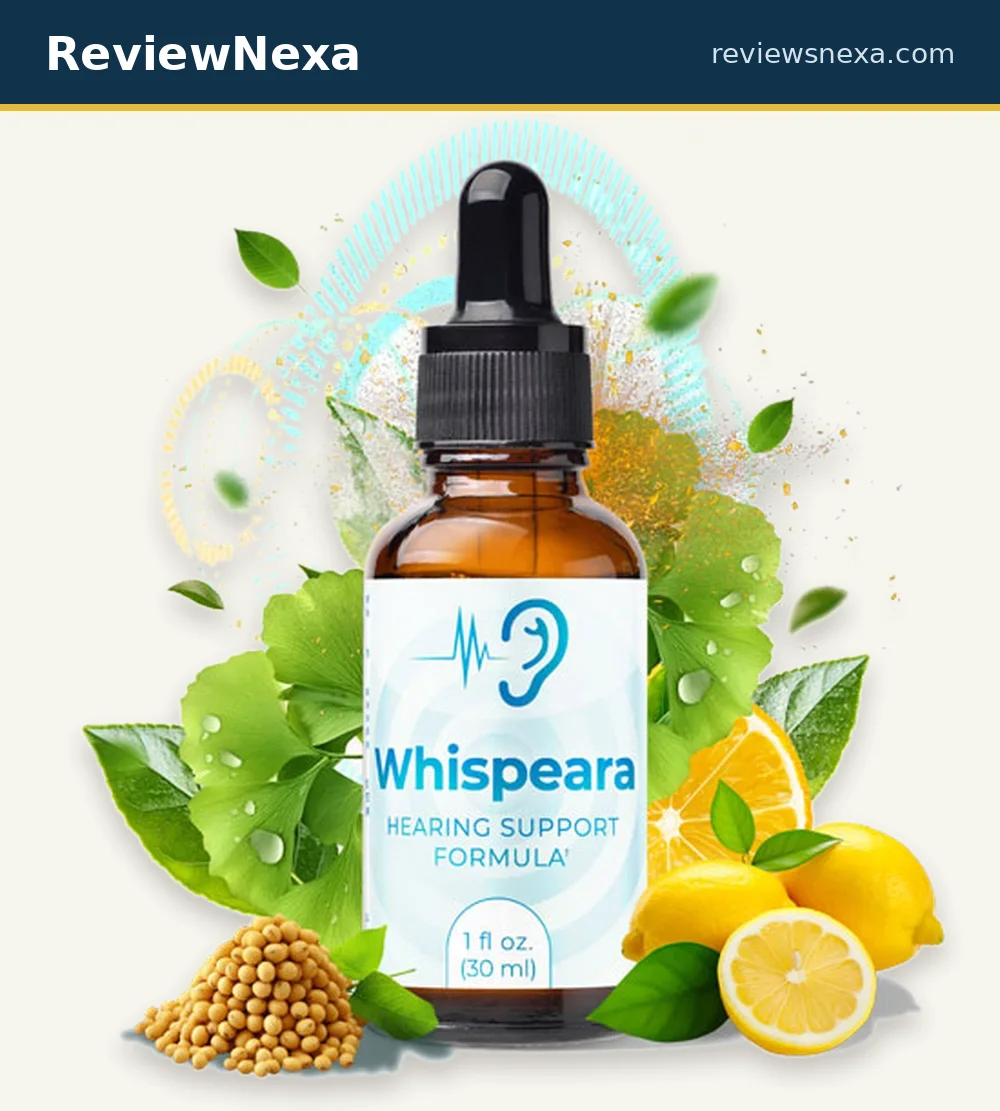
- Liquid dropper format
- 6-ingredient formula
- 90-day empty-bottle guarantee
- Sold only on vendor’s site
Whispeara Specifications
| Product Name | Whispeara |
|---|---|
| Category | Mind & Brain |
| Product | Whispeara |
| Format | Liquid dietary supplement — 1 fl oz (30 ml) amber glass dropper bottle, once daily |
| What it claims | Per the vendor: supports hearing clarity, eases tinnitus-related discomfort, supports inner-ear health, and promotes mental calm |
| Ingredients | Maca Root, Grape Seed Extract, Green Tea Extract, Capsicum Annuum, Gymnema Sylvestre, GABA — individual doses undisclosed |
| Guarantee | 90-day, 100% money-back, explicitly covering empty bottles (vendor-stated) |
| Official source | Vendor sales page (via the affiliate link on this page) |
| Pricing | Check the official website for current pricing and package options. |
| Availability | Official website only — verify at checkout. |
Most tinnitus products sell you a miracle and hand you a mystery. Whispeara does the selling differently, at least on the surface: it’s a small amber dropper bottle of herbal liquid, taken once a day under the tongue, and the vendor keeps telling buyers not to expect overnight results. In a category built on hype, that kind of patience is rare enough to be worth a closer look.
This review is the unvarnished version — what’s actually in the bottle, which claims the published research can back up and which it can’t, how the pricing and 90-day guarantee really work, and the weak spots nobody volunteers to you. The short version, up front: the ingredient logic holds together better than most competitors’, but the individual doses aren’t disclosed, there’s no clinical trial on the finished product, and the bolder hearing claims have nothing behind them. If that trade-off works for you, fine — and if it doesn’t, that’s exactly what this review is here to help you see.
- The current formula is a six-ingredient liquid — Maca Root, Grape Seed, Green Tea, Capsicum Annuum, Gymnema Sylvestre, and GABA. Older “spray” reviews floating around describe a different revision, so check the label on the actual bottle.
- No clinical trial exists on Whispeara itself. The ingredient science is plausibility-level, and since individual doses aren’t disclosed, published research can’t be mapped onto this product.
- Vendor guidance is genuinely gradual: possible early signals in the first week, best results around three months of consistent daily use.
- The 90-day money-back guarantee explicitly covers empty bottles and runs through ClickBank checkout — buyer-friendly by this category’s standards.
- It’s priced in tiers (roughly $49–$79 per bottle at last check) and sold only on the vendor’s own order page. Prices change — verify at checkout.
What Is Whispeara?
Whispeara is a natural liquid dietary supplement marketed for hearing support — specifically for tinnitus, the ringing, buzzing, or hissing that many people hear when no external sound is present. A secondary marketed benefit is mental calm and clearer focus. It isn’t a drug, isn’t a hearing device, and isn’t presented as a cure for diagnosed hearing loss; it’s a daily supplement dropper positioned between those worlds.
The format is straightforward: a 1 fl oz (30 ml) amber glass dropper bottle. Current guidance on the offer page is one full dropper — roughly 15 drops — once daily, either under the tongue or dissolved in water or juice. One thing worth knowing before you dig through third-party reviews: a batch of older syndicated press releases describes Whispeara as a liquid spray, six sprays a day, with a completely different ingredient list. That’s an older revision of the product, not a description error you should worry about — but it does mean you can’t trust random review-site ingredient lists. The bottle label is the authority.
Sales run through the vendor’s own order page, with payment processed by ClickBank. There’s no Amazon or pharmacy presence on offer, which matters when we get to counterfeit risk. As for who’s behind it: detailed reviews name a creator and a “research” brand attached to the product, but the naming conflicts across sources and there’s no verifiable corporate identity, registered business address, or independent record to anchor it. Treat the named creator as marketing copy rather than a credential. Vendor-stated manufacturing claims — assembled in the USA in an FDA-registered, GMP-certified facility, non-GMO, free of common allergens — are just that: vendor-stated, not independently verified. Nothing here indicates the product is FDA-evaluated as a treatment for any condition.
Product Facts at a Glance
| Product | Whispeara |
|---|---|
| Category | Mind & Brain |
| Format | Liquid dietary supplement — 1 fl oz (30 ml) amber glass dropper bottle, once daily |
| What it claims | Per the vendor: supports hearing clarity, eases tinnitus-related discomfort, supports inner-ear health, and promotes mental calm |
| Ingredients | Maca Root, Grape Seed Extract, Green Tea Extract, Capsicum Annuum, Gymnema Sylvestre, GABA — individual doses undisclosed |
| Guarantee | 90-day, 100% money-back, explicitly covering empty bottles (vendor-stated) |
| Official source | Vendor sales page (via the affiliate link on this page) |
How It Works
The vendor’s pitch is essentially a two-front strategy, and honestly it reads better than most. The first front is the ear itself: antioxidants (grape seed, green tea) aimed at protecting inner-ear structures from oxidative stress, plus circulation support — the idea being that healthy blood flow to the auditory system keeps it functioning well. The second front is the brain: GABA, the nervous system’s main calming neurotransmitter, is pitched as a way to quiet the overactive auditory signaling associated with tinnitus, with maca and gymnema folded in for metabolic and energy support.
That combination — peripheral ear protection plus central calming — is why the formula doesn’t read like a random herb pile. It’s a coherent story, and the ingredient choices follow it. You’ll also see the sales page lean on the phrase “6-Second Brain Mute Button.” That’s pure sales copy, not a medical term; the “six seconds” is a narrative device for the ritual of taking the drops, not a mechanism. Treat it as branding and move on.
Two honest caveats belong here, not later. First, the GABA part of the story depends on oral GABA reaching the auditory cortex in meaningful amounts — and whether that actually happens is actively debated in the research literature. The mechanism is plausible, not established. Second, everything above is the vendor’s framing. It’s a story about how the product might work, not proof that it does.
What’s Inside
The current formula lists six ingredients, though not a single individual dose — it’s a proprietary blend, so you’re trusting the vendor’s proportions. Here’s what each is generally known for, minus the sales-page gloss:
- Maca Root — a Peruvian root with a long traditional-use history, studied for adaptogenic and energy-support properties. Its hearing relevance is indirect at best.
- Grape Seed Extract — rich in proanthocyanidin antioxidants; has published evidence for cochlear (inner-ear) antioxidant activity. One of the better-motivated inclusions.
- Green Tea Extract — EGCG and other catechins with vascular and antioxidant literature behind them. Relevant to the circulation-support angle.
- Capsicum Annuum — the pepper family’s active compounds have vasodilation and anti-inflammatory research. Again, circulation-logic, not ear-specific proof.
- Gymnema Sylvestre — best known for blood-glucose research. Its role here is presumably metabolic support, though the hearing connection is thin.
- GABA — the formula’s most distinctive ingredient: the brain’s primary calming neurotransmitter, linked in published research to tinnitus (researchers have observed lower auditory-cortex GABA in people with tinnitus). The catch is oral bioavailability — whether swallowed GABA reaches the auditory cortex in meaningful amounts is openly debated, and that debate applies squarely here.
A note of caution that genuinely matters: third-party reviews publish other ingredient lists — ginkgo, B12, magnesium, zinc variants — that match neither the current formula nor the older spray revision. Those are unverified and shouldn’t be relied on, especially for allergies. Verify against the actual bottle label; with conflicting lists in circulation, that step is non-negotiable.
What the Evidence Can and Cannot Establish
Start with the headline fact: we found no published peer-reviewed clinical trial on Whispeara as a finished formula. That’s the norm for this category, but it’s still the ceiling — everything below it is ingredient-level evidence, and without disclosed doses, even that can’t be properly mapped onto the product.
What exists is genuinely interesting without being conclusive. The GABA–tinnitus connection has real published research behind it — Sedley et al. in the Journal of Neuroscience (2015) reported lower auditory-cortex GABA in tinnitus patients, with later confirmations — which makes GABA the most mechanistically plausible ingredient in the bottle. But the bridge from “GABA matters in tinnitus” to “swallowed GABA quiets tinnitus” is exactly where the literature gets debated. Grape seed’s cochlear antioxidant evidence, green tea’s vascular literature, and the vasodilation research on capsaicin-family extracts all support the formula’s logic, not its effectiveness.
Two red flags in how evidence gets presented on the sales side. One review quotes striking stats — “78% better hearing within 45 days,” “65% reduced tinnitus” — that trace to no identifiable study; they’re unverifiable sales copy and we’re not repeating them as anything else. And the vendor’s science-references section names real institutions, but the page carries its own disclaimer that it isn’t endorsed by, sponsored by, or affiliated with them. Borrowed credibility is not endorsement. The honest posture for this product: a coherent multi-target formula whose claims rest on plausibility, not proof — and plausibility is a starting point, not a verdict.
Pros and Limitations
Pros
- A thought-out two-front formula — ear-targeted antioxidants plus brain-calming GABA — rather than a random herb pile.
- Liquid dropper format suits people who dislike capsules; sublingual liquids absorb faster than capsules.
- 90-day guarantee explicitly covering empty bottles, backed through ClickBank checkout — genuinely buyer-friendly for this category.
- Gradual vendor guidance (possible early signals in week one, best results around three months) — refreshingly patient for a hype-driven niche.
- One-time payments with no subscription or auto-rebilling, per current coverage of the offer.
Limitations
- No ingredient doses disclosed — published ingredient research can’t be mapped onto the formula.
- No clinical trial on the finished product, and no independent verification of what’s in the bottle.
- Third-party sites publish conflicting ingredient lists from an older spray revision — the label is the only authority.
- Creator naming conflicts across sources; no verifiable corporate identity behind the brand.
- Online-only sales of a small dropper bottle — easy to imitate, so marketplace counterfeit risk is real.
- Reported effects are gradual and subtle; this is not a treatment for diagnosed hearing loss, and hearing restoration isn’t supported.
- Sales-page social proof (4.98/5, “2,000+ reviews,” “96% order 6 bottles”) is unverifiable, and the “no complaints ever” claim is contradicted by mild complaint reports.
Price & Refund
At last check (September 2026 — prices move, so verify at checkout), the vendor’s offer page listed three tiers: 2 bottles at $158 ($79 per bottle, plus shipping), 3 bottles at $177 ($59 per bottle, free US shipping), and 6 bottles at $294 ($49 per bottle, free US shipping). The 3- and 6-bottle packages include two digital bonus eBooks — “The Deep Sleep Activation Protocol” and “The Brainwire Regeneration Blueprint.” Older sources quote $69 per bottle; that’s stale pricing from an earlier revision and shouldn’t be treated as current.
The guarantee is the strongest part of the commercial picture: 90 days, 100% money-back, explicitly covering even empty bottles, per vendor materials. The practical mechanics matter more than the headline: a return authorization must be requested within 90 days of purchase, all bottles go back to a returns address in Aurora, Colorado (per 2026 consumer coverage), and the refund is the full purchase price minus shipping and handling, issued within about 48 hours of the return being received. Keep your ClickBank receipt and order confirmation — you’ll want them if you ever file. US shipping is generally quoted at 5–7 business days (one review saw up to 10); international orders take longer, with no specifics given.
Who May Consider It
In plain terms: an adult who’s bothered by persistent ringing or hissing, prefers a non-drug option, and is comfortable with modest, gradual expectations — and with taking a supplement whose individual doses aren’t disclosed. This isn’t medical advice, and it isn’t a recommendation; it’s a description of who the product seems built for.
Skip it, or talk to a doctor or pharmacist first, in these cases: pregnancy or breastfeeding (not tested in these groups), under-18s, or anyone taking sedatives, sleep aids, anti-anxiety medication, or blood-pressure drugs — the most-reported early effect is mild drowsiness, consistent with the GABA content, and stacking sedatives is a real consideration. Evening use suits most people; don’t drive drowsy. And the red-flag rule overrides everything: sudden, one-sided, or rapidly worsening hearing symptoms, dizziness, vertigo, or ear pain mean prompt medical evaluation — not a supplement.
Questions to Ask Before Buying
- Does the bottle label match the six-ingredient formula described here — or the older spray revision some third-party reviews describe?
- Am I taking anything the mild calming and drowsiness could interact with — especially sedatives, sleep aids, or blood-pressure medication?
- Am I clear on the guarantee mechanics — return authorization within 90 days of purchase, all bottles returned, refund minus shipping and handling?
- Am I buying from the actual vendor order page, rather than a marketplace copycat?
- Are my expectations calibrated — gradual, subtle support over months, not a cure for diagnosed hearing loss?
FAQ
Can Whispeara cure tinnitus?
No. And no supplement can. Whispeara is positioned as support for tinnitus-related discomfort and hearing clarity, not a cure, and the vendor doesn’t claim it cures anything either. Anyone selling a tinnitus cure is selling fiction.
Will Whispeara restore lost hearing?
No. There is no evidence supporting hearing restoration from this or any supplement, and the vendor’s own materials don’t promise it. Its pitch is supporting auditory health and easing tinnitus discomfort — a very different thing from reversing diagnosed hearing loss.
Is Whispeara safe to take every day?
Yes. Within the usual supplement caveats. No serious adverse events surfaced across the reviews read, but that isn’t proof of safety. The most-reported effect is mild drowsiness in the first week (consistent with the GABA content), a few reviewers noted early digestive discomfort, and it isn’t tested for pregnant or breastfeeding women or under-18s. If you take sedatives, sleep aids, or blood-pressure medication, check with your doctor or pharmacist first.
Does Whispeara work right away?
No. It’s gradual by design. The vendor’s own guidance says some people notice a difference after the first week, with the best results around three months of consistent daily use. That slow timeline is one of the product’s more credible features, actually; overnight results in this category are a fiction.
Is there really a money-back guarantee?
Yes. 90 days, 100% money-back, explicitly covering even empty bottles, per the vendor’s materials. The details matter: request a return authorization within 90 days of purchase, return all bottles to the stated returns address, and expect a refund minus shipping and handling within about 48 hours of receipt. Keep your ClickBank confirmation as proof of purchase.
Can I buy Whispeara on Amazon or in a store?
No. It’s sold only through the vendor’s own order page, with ClickBank handling checkout. That also means any listing you see on a marketplace is unofficial, and for a small dropper bottle that’s easy to imitate, the counterfeit risk is worth taking seriously.
Is Whispeara a scam?
No. Whispeara is a real, purchasable product that ships through ClickBank, with a stated 90-day money-back guarantee backing every order. "Scam" would mean fake goods or vanished payments, and we found no evidence of that.
Is Whispeara worth buying?
Depends. Whispeara is worth trying if the formula matches your specific concern and you're comfortable with the price — especially with the 90-day money-back guarantee removing most of the risk. It is not worth buying if you expect overnight or guaranteed results, because no supplement can promise those.
Our Verdict: Whispeara
Related Reviews



Testing statement: Desk research · No hands-on or clinical testing.