
Last Updated On September 30, 2026 by ReviewNexa Editorial
HepatoBurn Review: The Liver-First Fat-Loss Pitch, Examined
An interesting premise — that your liver quietly controls fat metabolism — wrapped in a sales pitch we’ll untangle honestly: conflicting ingredient lists, an unproven “clinical study,” and what the botanicals can actually do.
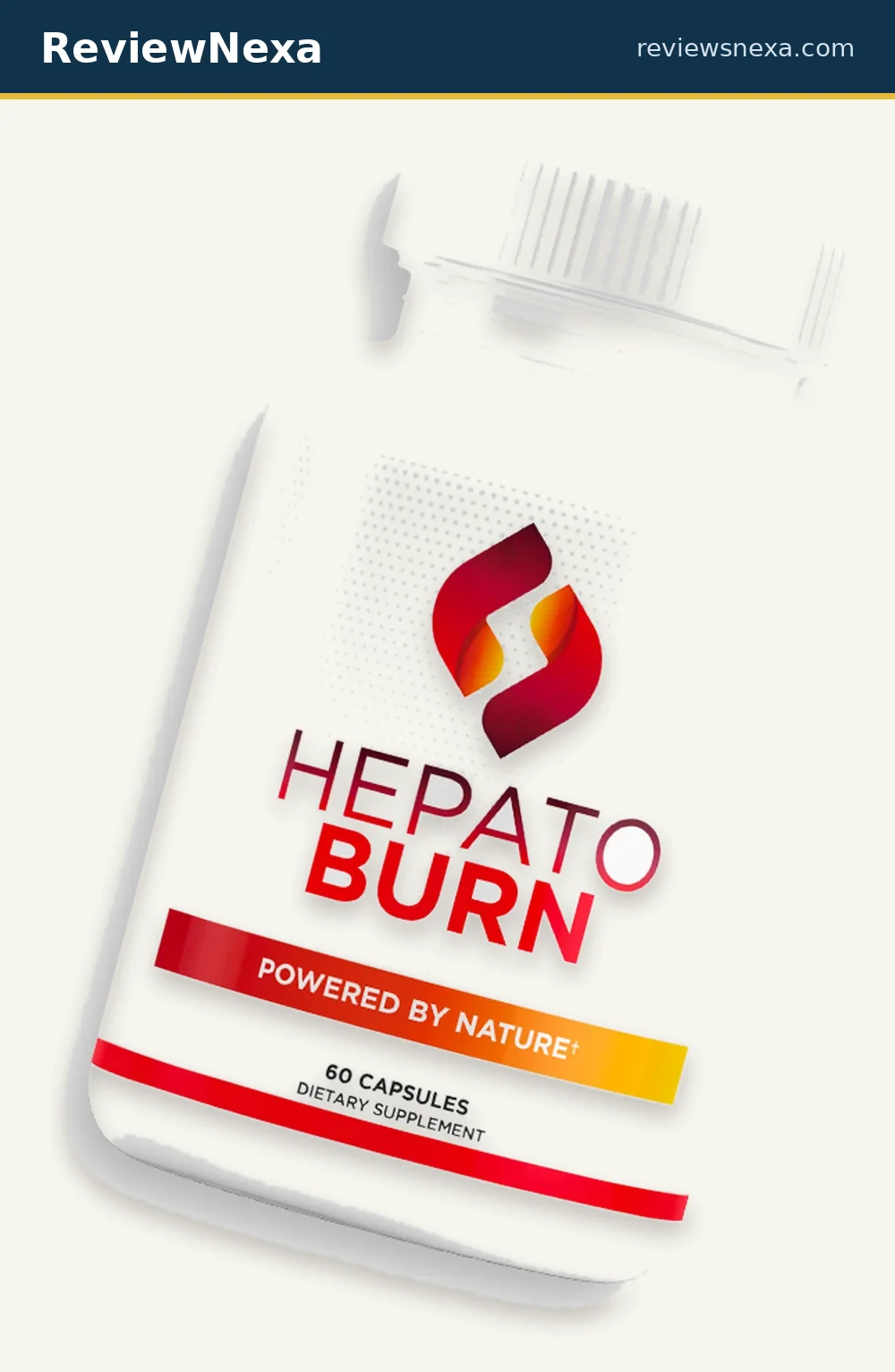
- Capsule supplement
- 100% stimulant-free
- Vendor-recommended 3–6 months
- Money-back guarantee (confirm length)
HepatoBurn Specifications
| Product Name | HepatoBurn |
|---|---|
| Category | Weight Management |
| Product | HepatoBurn |
| Format | Capsules; review coverage consistently says 1–2 daily with a large glass of water |
| What it claims | The vendor claims supporting liver function helps unlock fat metabolism and steady energy; marketed as 100% stimulant-free |
| Guarantee | Money-back guarantee advertised; sources cite 60 or 90 days — verify the exact wording on the live checkout page |
| Official source | Vendor sales page (via the affiliate link on this page); review sites warn of counterfeits on third-party marketplaces |
| Pricing | Check the official website for current pricing and package options. |
| Availability | Official website only — verify at checkout. |
Most weight-loss supplements start with stimulants and the familiar “boost your metabolism” promise. HepatoBurn takes a different swing: it claims the real culprit behind stubborn weight gain isn’t your willpower or even your diet — it’s a sluggish liver. The idea isn’t crazy. Your liver genuinely sits at the center of fat metabolism and detoxification. The question this review digs into is whether this particular bottle of capsules delivers anything meaningful on top of that premise.
I went through six review articles, the vendor’s sales presentation, and the general literature on the botanicals involved. What surfaced was a product with a plausible theory, a surprisingly murky ingredient picture — different review sites describe materially different formulas — and marketing claims that range from optimistic to outright fabricated. Here’s the honest breakdown: what’s corroborated, what’s conflicting, and what nobody can verify.
- Plausible premise, long leap. The liver does govern fat metabolism — that part is real physiology. “This capsule melts belly fat” is a long leap from it.
- The formula is unclear. Two incompatible ingredient descriptions circulate; the vendor’s sales page doesn’t publish a readable Supplement Facts panel. What’s actually in the bottle is genuinely uncertain.
- Reject the hype. The “mysterious red phenol,” the 2025 double-blind “study,” and the “X times more effective” multiples are marketing — none of them is established evidence.
- What to expect, realistically. Buyer accounts describe slow, mild effects over months — less bloating, steadier energy — not rapid transformation. Stimulant-free, so no jitters, but mild digestive discomfort in the first week is the most commonly reported downside.
- Verify money terms live. Sources conflict on price and on whether the guarantee is 60 or 90 days. Confirm both on the checkout page before buying.
What Is HepatoBurn?
HepatoBurn is a capsule-form dietary supplement sold online through a video sales letter, with checkout handled via ClickBank. Its whole positioning rests on one theory: that impaired liver function — not calories, willpower, or exercise alone — is the root cause of stubborn weight gain, a slow metabolism, and flagging energy. Clean up the liver, the pitch goes, and fat loss follows.
One part of that deserves credit: the liver-fat connection is established physiology. The liver processes fats, produces bile, and plays a central role in metabolic regulation. A genuinely overburdened liver (as in diagnosed fatty-liver disease) is a medical problem, not a supplement problem — and we’ll come back to that distinction. As a marketing theory, though, “liver-first fat loss” is at least more interesting than the usual stimulant treadmill. Reviews consistently report the product is 100% non-stimulant: no caffeine, no jittery thermogenic ingredients, which sets it apart from most fat-burners on the market.
Where it starts to wobble is everything built on top of the premise. The sales presentation wraps the theory in “mysterious red phenol” language, giant customer counts, and “many times more effective than ordinary fat burners” multiples — all of it unverifiable sales copy. And one review site’s claim of an “independent double-blind, placebo-controlled study” from 2025, complete with visceral-fat and resting-metabolic-rate numbers, has no registry entry, no publication, and no verifiable trail anywhere. We reject it outright: it isn’t evidence, it’s fiction dressed as science.
Product Facts at a Glance
| Product | HepatoBurn |
|---|---|
| Category | Weight Management |
| Format | Capsules; review coverage consistently says 1–2 daily with a large glass of water |
| What it claims | The vendor claims supporting liver function helps unlock fat metabolism and steady energy; marketed as 100% stimulant-free |
| Guarantee | Money-back guarantee advertised; sources cite 60 or 90 days — verify the exact wording on the live checkout page |
| Official source | Vendor sales page (via the affiliate link on this page); review sites warn of counterfeits on third-party marketplaces |
How It Works
As the vendor describes it, HepatoBurn works in two movements. First, a set of botanicals — milk thistle, artichoke, dandelion, turmeric, ginger — is meant to “purify” the liver and support bile flow, clearing what the marketing calls metabolic congestion. Second, a “fat-burning” blend — choline, green-tea extract, resveratrol and related polyphenols, depending on which ingredient description you believe — is supposed to turn that cleaner liver into a more efficient fat-metabolizing machine.
Strip away the poetry and the mechanism is: support liver function with familiar botanicals, supply nutrients involved in fat transport (like choline), and let the body’s normal fat metabolism run more smoothly. That’s a defensible framework — none of these ingredients is exotic or suspicious on its own. But the vendor presents it as a near-causal chain from capsule to melted belly fat, and that framing has no product-specific evidence behind it. No trial of HepatoBurn itself exists in any source we found. The honest version: plausible mechanism, zero direct proof.
What's Inside
This is where honesty demands we slow down, because the ingredient picture is genuinely murky. Two materially different formula descriptions circulate in reviews, and the vendor’s sales page doesn’t publish a readable Supplement Facts panel — no source we found reproduces a photo of the actual bottle’s label. So neither description can be confirmed as the current formula.
Description one — mirrors of the vendor’s FAQ — lists two proprietary blends (“Liver Purification Complex” and “Liver Fat-Burning Complex”) containing milk thistle, resveratrol, green-tea EGCG, choline, betaine, chlorogenic acid, genistein, glutathione, molybdenum, plus NAC, alpha-lipoic acid, turmeric, artichoke, zinc, and selenium. If this version is right, no individual doses are disclosed — dose transparency is effectively zero. Description two — a dose-listed review — gives milk thistle extract 150 mg, artichoke leaf 100 mg, dandelion root 100 mg, choline 82.5 mg, turmeric root 100 mg, beet root 100 mg, L-methionine 50 mg, molybdenum 10 mcg, and ginger root 100 mg. No proprietary blends, no resveratrol, a quite different formula.
A note on berberine: it shows up on some circulating ingredient lists and not on others — and with no readable label published, there’s no way to confirm it either way. We don’t list it as a confirmed ingredient here. But the uncertainty itself matters: anyone on prescription medication — especially blood-sugar medication or blood thinners, which berberine is known to interact with if present — should check the actual bottle label and talk to their doctor before using this.
The corroborated overlap — the names that appear across most sources — is reassuring in one way and thin in another: milk thistle, artichoke, dandelion, turmeric, ginger, and choline show up nearly everywhere. Those are the familiar, well-tolerated liver-support botanicals. But “familiar names” isn’t the same as “verified label,” and a buyer today can’t confirm what’s actually in the bottle until it arrives.
What the Evidence Can and Cannot Establish
Let’s separate the botanicals’ general literature from the product. Milk thistle (silymarin) is the most-studied liver botanical, with research exploring liver-protective and antioxidant effects — results are mixed, not slam-dunk. Green-tea EGCG has modest evidence for small increases in energy expenditure and fat oxidation; real, but small. Choline is an essential nutrient for moving fat out of the liver, and deficiency is linked to fatty liver — sound nutrition, not a fat-loss drug. Artichoke, dandelion, turmeric, and beetroot have traditional use and some supportive evidence for bile flow, liver enzymes, and antioxidant activity. The remaining polyphenols (resveratrol, chlorogenic acid, genistein) have weak-to-preliminary human weight-loss evidence.
What the evidence cannot establish: that HepatoBurn itself causes fat loss. No clinical trial of this product exists. The “2025 double-blind study” claim circulating on one review site — complete with specific visceral-fat and metabolic-rate figures — has no publication, registry entry, or verifiable trace. Treat it as a fabrication. Buyer accounts are anecdotes, and the widely syndicated “90-day diary” is third-party advertorial content, not independent journalism — worth reading as one buyer’s experience, not as data.
Pros and Limitations
Pros
- Stimulant-free formula — no caffeine, jitters, sleep disruption, or blood-pressure spikes, unlike most fat-burners.
- Built on real liver botanicals (milk thistle, artichoke, dandelion, turmeric) with genuine research behind them as individual ingredients.
- Money-back guarantee advertised, giving some downside protection if results disappoint.
- One-time purchase with no subscription, per vendor FAQ coverage — no auto-ship trap to cancel.
- Buyer accounts skew toward mild, sustainable-feeling effects (less bloating, steadier energy) rather than dramatic yo-yo cycles.
Limitations
- The confirmed formula is unverifiable — two incompatible ingredient lists circulate and the vendor publishes no readable Supplement Facts panel.
- No clinical trial of HepatoBurn itself; the cited “2025 study” is unverifiable and should be disregarded.
- Reported effects are slow and mild, not the transformation the sales video implies; the vendor itself suggests 3–6 months.
- Price and guarantee terms conflict across sources (60 vs 90 days; differing per-bottle prices) — you must verify live at checkout.
- Mild digestive discomfort or headache in the first week is commonly reported; taking it on an empty stomach can cause nausea.
- Anyone with diagnosed liver disease should see a doctor first — a supplement is not treatment for fatty liver or hepatitis.
Price & Refund
Published prices disagree across review sources, so treat every number below as a snapshot, not a fact: one source (January 2026) listed 2-bottle, 3-bottle, and 6-bottle tiers at roughly $79, $69, and $49 per bottle, with free shipping on the largest tier; another listed a single bottle around $69, three for about $177, and six for about $294; a September 2026 snapshot reported 2 bottles near $158, 3 near $207, and 6 near $294 with free US shipping on larger bundles. The “73% discount” and “save $900” framing is marketing language, not a stable price.
The refund picture is likewise split: most sources describe a 60-day, 100% money-back guarantee, while the newest source claims 90 days. Since checkout runs through ClickBank — which has its own refund infrastructure — the practical advice is simple: read the exact guarantee wording on the live checkout page before you pay, and confirm it in writing.
Who May Consider It
This is a product for someone who’s wary of stimulant fat-burners, likes the liver-first framing, and is comfortable with a slow, uncertain payoff — plus who has the patience and budget for the vendor’s recommended 3–6 months. It isn’t a product for anyone expecting fast or dramatic fat loss, anyone who wants a transparent, fully disclosed label before buying, or anyone on prescription medication who hasn’t talked to their doctor. And to be direct: if you have diagnosed liver disease — fatty liver, hepatitis, elevated enzymes — see a physician. A capsule from a sales video is not treatment.
Questions to Ask Before Buying
- Which ingredient list matches the bottle I’d actually receive — and why isn’t a Supplement Facts panel published?
- What is the exact guarantee length on the checkout page today — 60 days or 90 — and how does the refund process work?
- Am I on any prescription medication that could interact with botanical ingredients, given the ingredient confusion?
- Do I have diagnosed liver issues that mean I should be seeing a doctor instead of ordering a supplement?
- Am I prepared to give it several months with modest expectations, rather than expecting visible change in weeks?
- Am I buying only through the vendor’s official checkout, avoiding third-party marketplace listings where counterfeits have been reported?
FAQ
Does HepatoBurn actually burn fat?
No. Not in any proven sense. There’s no clinical trial of HepatoBurn itself, and the vendor’s “liver-first” mechanism is a plausible framework, not demonstrated proof. Buyer accounts describe gradual, mild body-composition changes over months at best.
Is HepatoBurn safe to take?
Yes. By the available reporting, its profile is mild and stimulant-free, with the most common issues being short-lived digestive discomfort or headache in the first week. That said, anyone on prescription medication, pregnant or nursing, or with diagnosed liver disease should consult a doctor first.
Does HepatoBurn contain berberine?
No. Not that anyone can confirm. Berberine appears on some circulating ingredient lists and not on others, and with no readable Supplement Facts panel published, its presence in the bottle is genuinely uncertain. If you take blood-sugar medication or blood thinners, which berberine is known to interact with if present, talk to your doctor first — and check your actual bottle label on arrival.
What is the money-back guarantee?
A money-back guarantee is advertised, but sources disagree on whether it’s 60 or 90 days, so verify the exact wording on the live checkout page before purchasing.
Is the 2025 clinical study real?
No. The “independent double-blind, placebo-controlled study” claimed on one review site has no publication, registry entry, or verifiable trace anywhere. We found no study, no registry, and no paper; treat the claim as unverified marketing.
Can I buy HepatoBurn on Amazon?
No. It’s sold only through the vendor’s official checkout, and multiple review sites warn of counterfeit, expired, or repackaged bottles on third-party marketplaces. Buying elsewhere risks a fake product with no guarantee coverage.
Can I expect results within weeks?
No. Results, when buyers report them at all, arrive slowly: the vendor suggests 3–6 months of consistent use, and the more credible buyer accounts describe early digestion and energy improvements in weeks one to four, with any visible change appearing much later. Anyone promising weeks should be doubted.
Is Hepatoburn a scam?
No. Hepatoburn is a real, purchasable product that ships through ClickBank, with a stated 60-day money-back guarantee backing every order. "Scam" would mean fake goods or vanished payments, and we found no evidence of that.
Is Hepatoburn worth buying?
Depends. Hepatoburn is worth trying if the formula matches your specific concern and you're comfortable with the price — especially with the 60-day money-back guarantee removing most of the risk. It is not worth buying if you expect overnight or guaranteed results, because no supplement can promise those.
Our Verdict: HepatoBurn
Related Reviews
Testing statement: Desk research · No hands-on or clinical testing.
5 thoughts on “HepatoBurn Review: The Liver-First Fat-Loss Pitch, Examined”