
Last Updated On September 30, 2026 by ReviewNexa Editorial
Nerve Armor Review: A Transparent Formula Wrapped in Overhyped Marketing
The label discloses every dose — genuinely rare in this niche — but the marketing invents a villain called “termite cells” and promises results within days. Here’s what actually holds up, and what doesn’t.
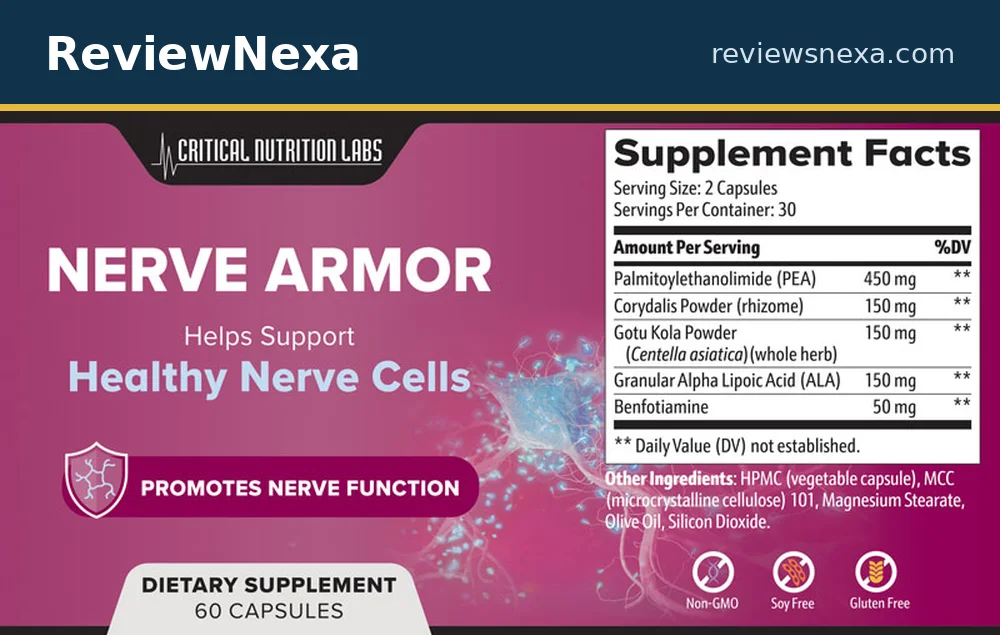
- PEA-Based Formula
- 60 Capsules / Bottle
- 2 Capsules Daily
- 60-Day Money-Back Guarantee
Nerve Armor Specifications
| Product Name | Nerve Armor |
|---|---|
| Category | Nerve Health |
| Product | Nerve Armor |
| Format | 60 vegetarian capsules — 30-day supply at 2 capsules daily |
| What it claims | Per the vendor: supports nerve comfort and helps calm everyday tingling, burning, and "pins and needles" — framed around its "termite cells" marketing story |
| Guarantee | 60-day money-back guarantee advertised; refunds requested by email — confirm terms at checkout |
| Official source | Vendor sales page (via the affiliate link on this page) |
| Pricing | Check the official website for current pricing and package options. |
| Availability | Official website only — verify at checkout. |
Search for help with tingling, burning, or pins-and-needles sensations and you’ll quickly meet Nerve Armor — a capsule supplement aimed at adults dealing with everyday nerve discomfort in their hands and feet. The product itself is better built than most of its competitors: the label lists every ingredient and dose, with no proprietary blend hiding the details. The marketing around it, though, is another story — it leans hard on a concept called “termite cells” supposedly attacking your nerves, and that concept doesn’t exist in any medical textbook we can find.
Bottom line, before we get into the details: at $59 a bottle, you’re buying a reasonably formulated PEA-based supplement with 450 mg of its best-studied ingredient per serving — not a treatment, not a cure, and not “clinically proven” the way the sales page implies. No study has tested this exact formula on people, only its individual ingredients, and the vendor’s “noticeable in 3–7 days” promise is unverified. If you can live with that balance — a well-dosed supplement, honest about what it is — this review covers everything else you should know: the full ingredient breakdown, what the research actually says, pricing and refund terms, and who should steer clear.
- Fully disclosed label — no proprietary blend: 450 mg PEA, 150 mg each of corydalis, gotu kola, and alpha-lipoic acid, plus 50 mg benfotiamine per 2-capsule serving.
- The “termite cells” storyline is a vendor marketing metaphor, not a recognized medical term — judge the formula, not the fiction.
- Evidence is ingredient-level only: no published clinical trial of Nerve Armor itself, and some of the ingredient research is mixed.
- It’s a dietary supplement, not a drug — it doesn’t treat neuropathy or any diagnosed condition. Anyone managing diabetes or taking medication should involve their doctor first.
- Sep-2026 reported pricing: $59 for one bottle, $147 for three, $234 for six; a 60-day money-back guarantee is advertised. Confirm pricing and shipping at checkout.
What Is Nerve Armor?
Nerve Armor is a capsule-based dietary supplement sold exclusively through the vendor’s own online checkout, positioned for adults with everyday nerve discomfort — tingling, burning, numbness, or that “pins and needles” feeling, mostly in the hands and feet. One thing worth getting straight from the start: it’s marketed as nutritional support, not as a drug, and nothing about it treats neuropathy or any diagnosed condition. That’s the vendor’s own positioning, and it’s the only honest way to read the product.
What makes it stand out in its category is label transparency, which is harder to find than it should be among nerve supplements. Every dose is disclosed — no proprietary blend, no “proprietary matrix” games. It’s made in the USA in a GMP-certified facility, and the free-from profile is decent: non-GMO, soy-free, gluten-free, with vegetable capsules that one reviewer describes as vegan-friendly. The serving is two capsules a day, taken with food and water; each 60-capsule bottle is a 30-day supply.
A word on the review landscape, because it affects everything you’ll read about this product: affiliate review sites dominate the search results, and no genuine Trustpilot or BBB listing turned up. That means third-party buyer feedback is thin and mostly filtered through pages that earn a commission. Keep that in mind — including with us, which is exactly why the disclosure sits at the top of this page.
Product Facts at a Glance
| Product | Nerve Armor |
|---|---|
| Category | Nerve Health (dietary supplement) |
| Format | 60 vegetarian capsules — 30-day supply at 2 capsules daily |
| What it claims | Per the vendor: supports nerve comfort and helps calm everyday tingling, burning, and “pins and needles” — framed around its “termite cells” marketing story |
| Guarantee | 60-day money-back guarantee advertised; refunds requested by email — confirm terms at checkout |
| Official source | Vendor sales page (via the affiliate link on this page) |
How It Works
The sales page tells it like this: microscopic “termite cells” are chewing through the myelin sheath — the protective coating around your nerves — and that’s what causes the tingling and burning. The formula’s ingredients are then supposed to counter that attack and support calmer, more comfortable nerves, with “noticeable results in 3–7 days” and nerves supported “64% quicker.” That’s the pitch, faithfully summarized.
Here’s the problem: the story is marketing fiction. “Termite cells” isn’t a diagnosis, a cell type, or anything a neurologist would recognize — it’s a metaphor invented to make the sales page more dramatic. If any of these ingredients do anything at all, it would be through their own studied pathways — PEA and alpha-lipoic acid have the most published research behind them — not by defeating imaginary insects. And the “3–7 days” timeline is unverified; the handful of anecdotal reviewer reports talk more in terms of weeks, when they report anything at all. So the fair way to evaluate this product is as a combination of ingredients with plausible, ingredient-level relevance to nerve comfort — not as the dramatic rescue mission the sales page describes.
What's Inside
- Palmitoylethanolamide (PEA) — 450 mg: the formula’s anchor by dose and by research weight. PEA is a fatty-acid amide the body produces naturally, and it’s the most published-on ingredient in this blend.
- Corydalis Powder (rhizome) — 150 mg: a traditional botanical whose alkaloids are of genuine pharmacological interest, though modern nerve-specific trials are limited.
- Gotu Kola Powder (whole herb) — 150 mg: long traditional use for circulation and tissue support; nerve-specific clinical data is thin.
- Alpha-Lipoic Acid (granular) — 150 mg: an antioxidant compound with research touching diabetic peripheral neuropathy — evidence mixed, and this dose is modest versus research settings.
- Benfotiamine — 50 mg: a fat-soluble derivative of thiamine (vitamin B1), investigated in diabetic nerve problems.
Beyond the actives, the label lists an HPMC vegetable capsule, microcrystalline cellulose, magnesium stearate, olive oil, and silicon dioxide. No proprietary blend — every amount above is printed on the label, which we verified across multiple independent-style reviews. One note on what we deliberately left out: several affiliate pages attach dramatic percentages to these ingredients (“460% reduction” in termite cells, “40% better absorption,” an “82.7% improvement” from a 2021 study). None of those figures comes with a verifiable citation, so they don’t belong in a facts section. Treat them as ad copy.
What the Evidence Can and Cannot Establish
PEA is the formula’s strongest leg. It occurs naturally in the body, and published research exists in chronic and neuropathic pain settings — including a 2012 analysis and later reviews. But every one of those studies tested PEA on its own, not Nerve Armor, and at doses that don’t necessarily line up with 450 mg. Ingredient-level support is real; formula-level proof simply doesn’t exist, and no published clinical trial of this finished product turned up anywhere.
Beyond PEA, the blend runs a gradient from “somewhat studied” to “mostly traditional.” Alpha-lipoic acid has been studied in diabetic peripheral neuropathy contexts with genuinely mixed results — some positive findings, more cautious reviews. Benfotiamine, the fat-soluble B1 derivative, has been investigated in diabetic nerve problems but remains early-stage. Corydalis brings pharmacologically interesting alkaloids with limited modern nerve-specific trials. Gotu kola has centuries of traditional use behind it for circulation, with thin nerve-specific clinical data. None of this is damning — it’s roughly what you’d expect from a botanical blend — but it’s a long way from “clinically proven.”
And here’s what the evidence cannot establish, no matter how the sales page phrases it: that this combination treats, reverses, or repairs any nerve condition; that myelin regrows; that results arrive in days; or that any of the percentage claims on affiliate pages mean anything. There’s also a meaningful gap between research doses and label doses for at least one ingredient. The honest reading is a transparently dosed mix of ingredients with plausible but unproven relevance to nerve comfort — and nothing more.
Pros and Limitations
Pros
- Every dose disclosed on the label — no proprietary blend, which is genuinely uncommon in this category
- PEA at 450 mg anchors the formula and is its most research-backed ingredient
- Clean free-from profile: non-GMO, soy-free, gluten-free, vegetarian capsules
- Made in the USA in a GMP-certified facility
- 60-day money-back guarantee advertised, giving buyers a backstop
Limitations
- No clinical trial of the finished formula — “clinically proven” is vendor language, not a verified fact
- The “termite cells” concept is a marketing invention, not medicine, and it runs through the entire sales pitch
- 150 mg of alpha-lipoic acid is modest versus research doses, and the evidence base is mixed
- $59 a bottle is steep next to simpler single-ingredient options
- Sold only through the vendor’s checkout; refunds run through email, which buyers describe as impersonal
- ALA can influence blood-sugar handling and botanicals can interact with medications — not a casual pick for anyone on meds without a doctor’s input
Price & Refund
Current pricing, per the freshest September 2026 reports, runs three tiers: one bottle at $59, three bottles at $147 (about $49 each), and six bottles at $234 (about $39 each). The vendor page also shows crossed-out “regular” prices — $125, $375, $750 — which is classic price anchoring; treat those as marketing context, not verified former prices. Older tiers ($69/$177/$294) still appear on stale affiliate pages and shouldn’t be relied on. On shipping, the two current sources agree that six-bottle orders get free US shipping; the single bottle ships for an added fee (one source puts it at $7.99), and reports conflict on the three-bottle tier. Bottom line: confirm the shipping cost at checkout before you pay.
A 60-day money-back guarantee is advertised across all sources, with refunds requested by email to customer support. One affiliate PDF claims even empty bottles are accepted — that’s vendor-attributed, not independently verified. Multi-bottle orders reportedly include bonus e-books or guides, also unverified. As with any supplement sold this way, prices, shipping, and guarantee terms can change — verify the current details on the vendor’s page before entering payment information.
Who May Consider It
Who’s this actually for? Someone who has done their homework, likes what they see in a fully disclosed label, and wants a PEA-centered supplement for everyday nerve-comfort support — with realistic expectations and money they’re comfortable risking on an uncertain outcome. If label transparency is your top criterion in this niche, this formula clears that bar.
More important than the fit, though, are the boundaries — and to be clear, this isn’t a recommendation. If you have diagnosed neuropathy or diabetes, take medication (especially for blood sugar), or are pregnant or breastfeeding — talk to your doctor before considering it. And if your symptoms are persistent or getting worse — ongoing numbness, burning, weakness, or loss of sensation — that needs a medical evaluation, full stop. A supplement is never the right first move for that.
Questions to Ask Before Buying
- Am I comfortable buying a formula that has never been tested in a clinical trial as a finished product?
- Have I checked with my doctor — especially if I manage diabetes or take any medication?
- Do the unverified claims on the sales page (“3–7 days,” “termite cells,” “clinically proven”) bother me enough to walk away?
- Have I confirmed the current price, shipping cost, and refund process at checkout before entering my payment details?
FAQ
Is Nerve Armor FDA approved?
No. It's sold as a dietary supplement, which the FDA doesn't approve the way it approves drugs. What the vendor states is a GMP-certified, FDA-registered manufacturing facility; the "FDA approved" wording on some affiliate pages overstates that.
Can Nerve Armor treat neuropathy or reverse nerve damage?
No. It's marketed as nutritional support for everyday nerve comfort, not as a drug or treatment — and no clinical trial of this formula exists. Anyone with diagnosed neuropathy needs a doctor's care, not a supplement.
What are “termite cells”?
No medical reality behind the term — it's a vendor marketing metaphor for whatever is supposedly damaging the myelin sheath. No neurologist or medical text recognizes "termite cells" — that's sales-page fiction, not science.
Is Nerve Armor safe?
Yes. With caveats — its ingredients are generally well tolerated at supplemental doses, with mild digestive upset the most plausible issue. But alpha-lipoic acid can influence blood-sugar handling and botanicals can interact with medications, so check with a clinician first if you're on meds, managing diabetes, or pregnant or breastfeeding.
Can I take it alongside diabetes medication?
No. Not without your doctor's explicit approval. Alpha-lipoic acid can affect blood-sugar handling, which is exactly the wrong thing to experiment with on your own while taking diabetes medication.
How soon will I feel anything?
No reliable answer exists. The vendor's "3–7 days" claim is unverified; the few anecdotal reviewer reports describe gradual changes over weeks — and plenty of buyers report little or no change. Anyone promising you a timeline is guessing.
Can I buy Nerve Armor in stores?
No. It's sold only through the vendor's own online checkout. Third-party listings carry counterfeit risk and wouldn't be covered by the guarantee, so they're not worth the gamble.
Is there a money-back guarantee?
Yes. A 60-day money-back guarantee is advertised, with refunds requested by email to customer support. Terms can change, so confirm the current guarantee details on the vendor's page before you buy.
Is Nerve Armor a scam?
No. Nerve Armor is a real, purchasable product that ships through the official checkout, with a stated 60-day money-back guarantee backing every order. "Scam" would mean fake goods or vanished payments, and we found no evidence of that.
Where can I buy Nerve Armor?
Through the official website. Nerve Armor is not sold on Amazon, eBay, or in retail stores — buying from the official site is the only way to guarantee an authentic product and qualify for the money-back guarantee.
Our Verdict: Nerve Armor
Related Reviews



Testing statement: Desk research · No hands-on or clinical testing.