
Last Updated On September 30, 2026 by ReviewNexa Editorial
Quietum Plus Review: A Tinnitus Formula Put Through Its Paces
An 18-ingredient capsule formula for ear health and tinnitus — we weighed the published ingredient evidence, the pricing, the conflicting guarantee terms, and the promotional noise surrounding it.
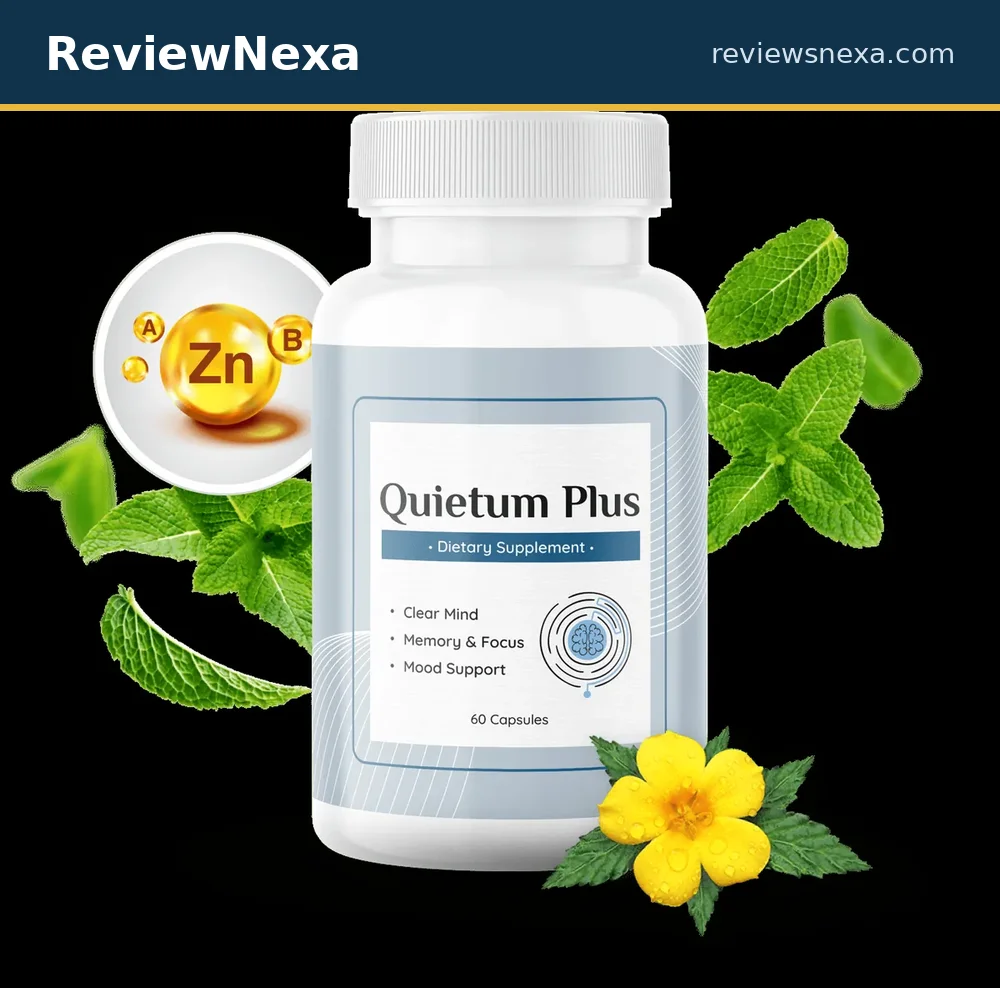
- Hearing-support capsules
- 2 per day · 30-day supply
- 60-day guarantee reported
- B12, zinc & ashwagandha core
Quietum Plus Specifications
| Product Name | Quietum Plus |
|---|---|
| Category | Hearing Health |
| Product | Quietum Plus |
| Format | Capsules — 2 per day, 60 per bottle (30-day supply) |
| What it claims | Nutritional support for the systems that influence tinnitus perception: circulation, nerve health, oxidative stress, and the stress-tension loop. The vendor does not present it as a treatment or cure — correctly so. |
| Guarantee | 60-day money-back reported by current sources; older materials cited 180 days. Confirm the exact terms at checkout. |
| Official source | Vendor sales page (via the affiliate link on this page) |
| Pricing | Check the official website for current pricing and package options. |
| Availability | Official website only — verify at checkout. |
Ringing in the ears is one of those symptoms that quietly rearranges a person’s life. Quiet rooms stop being quiet, sleep gets lighter, and conversations take more effort than they should. Conventional medicine doesn’t have much to offer tinnitus beyond management strategies — sound therapy, stress management, and a lot of waiting. Into that gap steps Quietum Plus, a capsule-based supplement built around botanicals, vitamins, and minerals, aimed at the systems thought to influence how tinnitus is experienced.
The short version of what we found: the formula has a small core of ingredients with genuinely relevant published research — vitamin B12, zinc, and ashwagandha — wrapped in a long tail of traditional botanicals with no tinnitus-specific evidence behind them. There’s no clinical trial on the complete blend, the company behind the product doesn’t publicly identify itself, and the guarantee terms conflict between older and current sources. None of that settles whether it does anything for you. It’s what a careful buyer should know before paying.
For this review we read the vendor’s materials, the reported ingredient lists, independent reporting on the offer, and the published literature behind the key ingredients. We also looked at how the product is talked about online — because with tinnitus supplements, the advertising ecosystem around a product is often louder than the product itself.
- A capsule supplement for ear health and tinnitus support — two capsules a day, 60 per bottle, sold only through the vendor’s official page.
- Roughly 18 botanicals, vitamins, and minerals. Only three — B12, zinc, ashwagandha — carry published research with direct relevance to tinnitus.
- No clinical trial exists on the full formula, and the company behind it isn’t publicly identified — two real transparency gaps.
- Pricing runs from about $69 for one bottle down to about $49 per bottle in bundles, as reported — but bundles, bonuses, and totals change, so verify live.
- A 60-day money-back guarantee is reported by current sources, yet older materials cited 180 days. Confirm the exact window on the checkout page before you order.
- Fair framing: a nutritional daily routine for mild-to-moderate cases, never a treatment — and anything sudden, one-sided, or accompanied by dizziness belongs with a clinician first.
What Is Quietum Plus?
It’s a dietary supplement in capsule form, marketed squarely at ear health — and specifically at tinnitus, the ringing, buzzing, or hissing that only the sufferer can hear. The core audience is adults noticing age-related hearing changes or living with persistent tinnitus who want a nutritional approach rather than a device or prescription.
The positioning is worth noting because it’s more modest than a lot of competitors’. Rather than promising to restore hearing, the vendor frames the formula as supporting the systems around hearing — blood flow toward the inner ear, oxidative stress around auditory nerves, inflammation, and the stress-tension cycle that amplifies how tinnitus is perceived. That last angle deserves attention: stress genuinely worsens tinnitus perception, so a formula aimed at the stress side of the loop is at least pointed at real physiology.
Then there’s the part the marketing doesn’t volunteer. The individual or company behind the formula isn’t publicly identified — there’s no founder, no “about the makers” page worth the name. For a product asking for your trust and your card details, that anonymity is a genuine gap. The vendor does state manufacturing in FDA-registered, GMP-certified US facilities and describes the capsules as non-GMO, gluten-free, stimulant-free, and non-habit-forming — but facility registration is a manufacturing standard, not product approval and not proof of efficacy.
One piece of marketing copy deserves translation: the claim that the formula “regenerates the wire connecting the ear to the brain.” Read it as advertising language. It’s vivid, and it isn’t a demonstrated medical mechanism.
Product Facts at a Glance
| Product | Quietum Plus |
|---|---|
| Category | Hearing Health |
| Format | Capsules — 2 per day, 60 per bottle (30-day supply) |
| What it claims | Nutritional support for the systems that influence tinnitus perception: circulation, nerve health, oxidative stress, and the stress-tension loop. The vendor does not present it as a treatment or cure — correctly so. |
| Guarantee | 60-day money-back reported by current sources; older materials cited 180 days. Confirm the exact terms at checkout. |
| Official source | Vendor sales page (via the affiliate link on this page) |
How It Works
This is the mechanism as the vendor describes it — not as proven fact. The official narrative lays out a three-step approach: first, targeted nutrients are delivered to the structures of the inner ear, like the cochlea and the auditory nerve, to shield them from oxidative stress and inflammation; second, calming and anti-inflammatory ingredients work on the tension that can amplify how tinnitus is felt; third, amino acids and circulatory botanicals support neurotransmitter balance and blood flow, which in theory keeps the signal path from ear to brain clearer.
Put less carefully, the pitch is that Quietum Plus is a kind of multivitamin for your ears — filling nutritional gaps that might affect auditory function. It’s a coherent story. What it isn’t is a demonstrated one: none of these pathways has been shown to change in users of this specific blend in any clinical trial. Ingredient-level research supports parts of the rationale; the leap from ingredients to outcomes in a bottle is exactly what no study has tested.
What's Inside
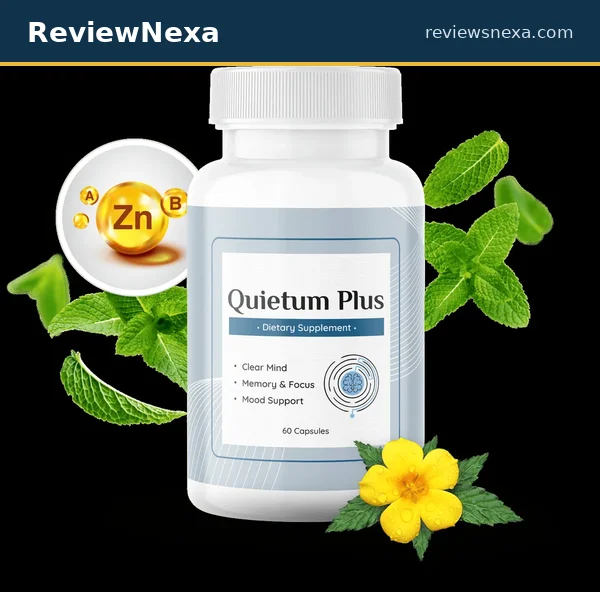
The Quietum Plus bottle — 60 capsules per bottle, two capsules daily per the reported dosing.
The most useful way to read this formula is as two tiers. The first tier is small and is where the evidence actually lives:
- Vitamin B12. The strongest tinnitus-specific ingredient in the blend. A 2025 systematic review found low B12 in roughly 37% of tinnitus patients, and an older study in the American Journal of Otolaryngology found B12 deficiency in 47% of noise-exposed personnel with tinnitus versus 19% in those with normal hearing. B12 matters for the myelin sheath around nerves, including the auditory nerve — and supplementation has shown symptom improvement in people who were genuinely deficient. The caveat: the benefit tracks with deficiency. Normal B12 levels, thinner case.
- Zinc. Documented role in cochlear and neuronal function. A 2022 study in Nutrients confirmed higher zinc deficiency rates in tinnitus patients than in age-matched controls, and a clinical trial on noise-induced tinnitus tested zinc supplementation with elevated treatment response in patients. Again, strongest where deficiency exists.
- Ashwagandha. The logic here runs through stress, not the ear. Multiple randomised controlled trials confirm its cortisol-reducing effects in adults, and chronic stress is a documented amplifier of tinnitus severity. Breaking the stress-tinnitus feedback loop is a plausible mechanism — even though direct ashwagandha-tinnitus trials are limited.
- Piperine (black pepper extract). Not an ear ingredient at all — it’s a bioavailability enhancer, included to improve absorption of the companion botanicals. Sound formulation practice, well documented.
Then comes the second tier: the long tail. Mucuna pruriens (a source of L-DOPA — one 2023 animal study showed reduced tinnitus severity in animals, but human data isn’t there), epimedium and tribulus for circulation, dong quai for traditional circulatory support, L-tyrosine and L-arginine around neurotransmitter and nitric-oxide pathways, plus ginger, garlic, hawthorn, and a spread of traditional herbs — yam, fenugreek, motherwort, hops, Pacific kelp, oat grass, buchu, red clover, sarsaparilla, asparagus, black cohosh — alongside vitamins A, C, and E. For these, the evidence is traditional use and broad, non-specific research — not tinnitus trials.
Two honesty notes on the label itself. First, the exact ingredient roster is reported slightly differently across sources — the 18-count figure is stable, the precise roster less so. Second, one review claims the label discloses individual dosages for all 18 ingredients, which would be unusual transparency in this category. We couldn’t independently verify a full label scan, so treat per-ingredient dosing as unconfirmed rather than established.
What the Evidence Can and Cannot Establish
What the evidence can establish is narrow but real: several individual ingredients touch pathways genuinely relevant to tinnitus. B12 and zinc deficiencies show up measurably more often in tinnitus populations than in controls, and correcting them in deficient people has shown benefit. Stress is a genuine amplifier of tinnitus perception, and ashwagandha has reasonable trial support for reducing the stress side of that loop. Those are legitimate, published findings — not marketing.
What it cannot establish is the thing you actually want to know: whether this bottle quiets tinnitus. Per-ingredient evidence doesn’t automatically transfer to a blend, and no clinical trial on the complete Quietum Plus formula exists. Tinnitus is also highly variable and placebo-responsive, which means anecdotal “it worked for me” reports — even sincere ones — can’t carry the weight buyers wish they could.
And the promotional layer deserves to be discounted to zero. The review landscape around this product is thick with affiliate pages carrying ratings like 4.7 to 4.92 out of 5 with no disclosed methodology, fabricated-sounding statistics (“87% improved by day 90” on a thousand-person snapshot that was never a study), and syndicated “news” pieces on lookalike domains. None of that is evidence. Stick to what you can actually verify — the ingredient list, the price, the guarantee in writing — and treat the promotional noise as exactly that: noise.
Pros and Limitations
Pros
- A small core of ingredients — B12, zinc, ashwagandha — with genuinely published relevance to tinnitus, not borrowed hype.
- Targets an underserved concern with a modest framing: supporting systems around hearing, not promising a cure.
- Reported 60-day money-back guarantee gives buyers a defined evaluation window — if the terms on the checkout page confirm it.
- Stimulant-free, non-GMO, gluten-free positioning, and piperine for absorption: signs someone thought about formulation, not just marketing.
Limitations
- No clinical trial on the full formula — the distance from plausible ingredients to proven outcomes is untested.
- The company behind the product isn’t publicly identified, and guarantee terms conflict across sources (60 vs 180 days).
- The promotional ecosystem around it is heavy with inflated ratings and invented statistics — you have to filter aggressively.
- Only sold through the official page, so comparison shopping is limited; marketplace listings carry counterfeit risk.
- Not a fit for severe, sudden, or trauma-related hearing symptoms — those need a clinician, not a supplement.
Price & Refund
Pricing as reported at research time: about $69 for one bottle (a 30-day supply), dropping to about $59 per bottle on the three-bottle package and about $49 per bottle on the six-bottle package, with free shipping and bonus extras on the bundles. One source listed a two-bottle tier at $79 per bottle — treat that as a reminder that these numbers move. The only figure you can trust is the one on the live checkout page.
The refund picture is where buyers should slow down. Current sources report a 60-day money-back guarantee processed through ClickBank — but older materials cited 180 days, and that conflict is exactly the kind of ambiguity that turns into a refund dispute later. Before ordering, confirm the exact window in writing on the checkout page and note the return procedure. The guarantee only applies to purchases through the official channel — marketplace listings come with no guarantee coverage and carry counterfeit risk.
Who May Consider It
The most sensible fit: adults with mild-to-moderate tinnitus who’ve already ruled out anything urgent, who are comfortable with a daily capsule routine for two to three months, and whose expectations are calibrated to “nutritional support,” not silence. People whose tinnitus flares with stress have the clearest mechanistic case for the formula, given the ashwagandha angle.
This is not medical advice, and it isn’t a recommendation — it’s a description of who the honest case for trying it covers. Skip it, or at least get professional guidance first, if your hearing symptoms are sudden, one-sided, or accompanied by dizziness or pain; if you’re pregnant, nursing, or under 18; or if you take medications like blood thinners that could interact with circulatory botanicals. A hearing evaluation comes before any supplement routine.
Questions to Ask Before Buying
- What guarantee window will actually appear on my checkout receipt — 60 days or 180? Don’t rely on older articles.
- Am I ordering on the official page, or a marketplace listing that carries no guarantee and counterfeit risk?
- Do I have any hearing red flags — sudden onset, one-sided ringing, dizziness, ear pain — that a clinician should see first?
- Am I taking any medications, especially blood thinners, that circulatory botanicals could interact with?
- Am I genuinely willing to take it daily for 60–90 days with no promise of change, and to walk away through the refund process if nothing happens?
FAQ
Does Quietum Plus cure tinnitus?
No. It isn’t a cure and the vendor doesn’t present it as one. It’s a dietary supplement positioned around nutritional support for ear health. There’s no clinical trial showing the formula eliminates tinnitus, and anyone selling you “cure” language for a supplement is overreaching.
Is there a clinical trial on the complete formula?
No. None has been published. The evidence discussion is entirely per-ingredient: B12, zinc, and ashwagandha have published research with tinnitus relevance, and the long tail of botanicals rests on traditional use. Ingredient evidence is real, but it doesn’t automatically transfer to the blend.
Is Quietum Plus safe for most healthy adults?
Yes. As a botanical-vitamin-mineral blend it’s generally considered safe at the labeled serving, with no serious side effects widely reported. Still, check with a clinician first if you take blood thinners or other prescriptions, and it isn’t intended for pregnancy, nursing, or under-18 use without medical guidance.
Could I expect to notice anything within a month?
No. No reliable timeline exists — and no guaranteed outcome at all. Public user reports that mention change tend to cluster around 60–90 days of consistent daily use, framed as a subjective softening of perception rather than silence. Treat any promised timeline in advertising as fiction.
Can I buy Quietum Plus on Amazon or in stores?
No. The vendor sells only through its official page. Third-party listings on marketplaces aren’t authorized channels, carry counterfeit risk, and won’t be covered by the money-back guarantee. That’s the product’s own stated warning.
Is Quietum Plus FDA approved?
No. It’s a dietary supplement, not an FDA-approved treatment for tinnitus or hearing loss. The “FDA-registered facility” and “GMP-certified” claims describe manufacturing standards, not product approval or proof that the formula works.
Is Quietum Plus a scam?
No. Quietum Plus is a real, purchasable product that ships through ClickBank, with a stated 30-day money-back guarantee backing every order. "Scam" would mean fake goods or vanished payments, and we found no evidence of that.
Does Quietum Plus have a money-back guarantee?
Yes. Every Quietum Plus order is covered by a 30-day money-back guarantee. If you're not satisfied, you can request a refund within 30 days of purchase — keep your order confirmation email as proof of purchase.
Is Quietum Plus worth buying?
Depends. Quietum Plus is worth trying if the formula matches your specific concern and you're comfortable with the price — especially with the 30-day money-back guarantee removing most of the risk. It is not worth buying if you expect overnight or guaranteed results, because no supplement can promise those.
Our Verdict: Quietum Plus
Related Reviews

Testing statement: Desk research · No hands-on or clinical testing.
2 thoughts on “Quietum Plus Review: A Tinnitus Formula Put Through Its Paces”