
Last Updated On September 30, 2026 by ReviewNexa Editorial
SonoVive Review: The “Hearing” Supplement That’s Really a Brain Formula
SonoVive is sold for hearing wellness, but its eight-ingredient label reads like a nootropic — here’s what that actually means for your expectations, plus the one safety warning nobody should skip.
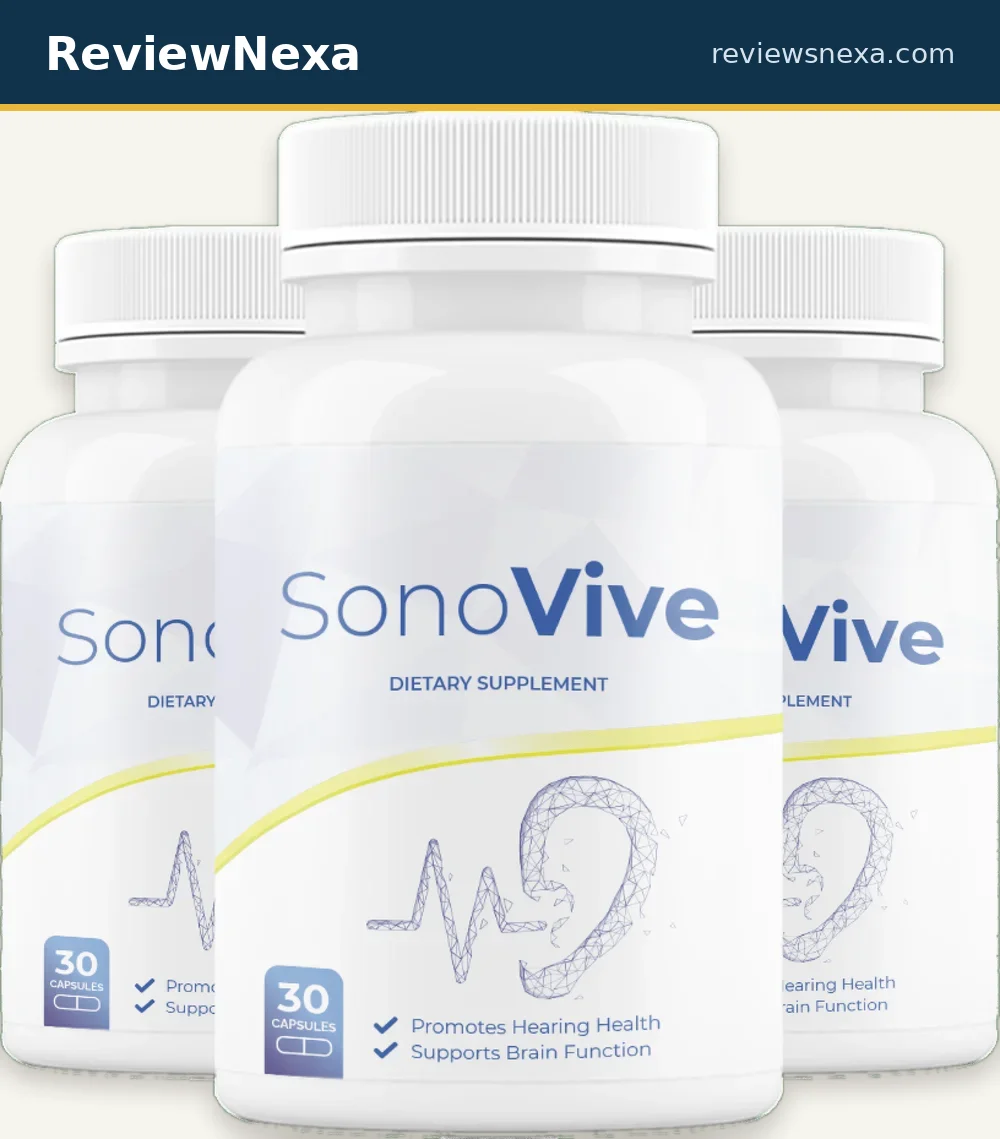
- 8-ingredient panel, doses disclosed
- 30 capsules per bottle
- 60-day money-back guarantee
- St. John's Wort safety caution
SonoVive Specifications
| Product Name | SonoVive |
|---|---|
| Category | Hearing Health |
| Product | SonoVive |
| Format | Capsules — 30 per bottle (30-day supply at one capsule/day). Label consensus: 1 capsule once or twice daily, with a meal and water. |
| What it claims | The vendor claims SonoVive supports hearing wellness and brain function through the "brain-ear connection," using an eight-ingredient plant-and-nutrient blend. |
| Guarantee | 60-day money-back guarantee, as stated by the vendor. Refund mechanics (return postage, authorization steps) are untested — save the exact wording at checkout. |
| Official source | Vendor sales page (via the affiliate link on this page) |
| Pricing | Check the official website for current pricing and package options. |
| Availability | Official website only — verify at checkout. |
Hearing supplements ask you to believe a lot, so with SonoVive I started where you should too: the Supplement Facts label, not the sales headline. And the label tells a genuinely interesting story. Eight ingredients, every single dose printed in the open — in a category drowning in proprietary blends, that kind of transparency is rare and worth crediting. But then comes the twist, and it’s a big one: nearly everything on that label was studied for memory, focus, or circulation. The argument for your ears rests entirely on a marketing idea called the “brain-ear connection,” and the science behind it is a whole lot thinner than the pitch suggests.
This review goes through what’s actually in the bottle, what the research can and can’t support, who needs to steer clear (anyone on prescription medication should read the safety section twice — St. John’s Wort is not a benign herb), and where the honest bottom line lands. No inflated claims, no borrowed star ratings, no pretending we tested it in a lab.
- SonoVive is a daily capsule supplement sold for hearing wellness and brain function — but its eight ingredients are mostly associated with memory, focus, and circulation research, not the ear itself.
- One genuinely good thing: every per-serving dose is published on the label (from St. John’s Wort at 250 mg down to Huperzine-A at 10 mcg). No hidden proprietary blend.
- The biggest red flag is St. John’s Wort at 250 mg per serving. It can blunt antidepressants, birth control, blood thinners, and transplant or HIV medications. Anyone on a regular prescription must take the label to a pharmacist or doctor first.
- No published trial of the finished product exists. Pricing runs $69 for one bottle down to $49 per bottle in a six-pack, with a stated 60-day money-back guarantee — confirm current terms at checkout.
What Is SonoVive?
SonoVive is a daily capsule dietary supplement marketed for hearing wellness with a side of brain support. The bottle holds 30 capsules — a 30-day supply at one capsule a day — and the consensus across reviews is one capsule once or twice daily, taken with a meal and water. One detailed reviewer suggests eight to twelve weeks as a fair window to judge anything at all, which seems about right for this kind of formula. As always, the label’s own directions are the definitive word.
The sales story credits the formula to “Sam Olsen,” described as a 65-year-old retired medical chemist who developed it for his own hearing. You’ll see that story repeated across review sites, but it traces back to the vendor’s own marketing, and I couldn’t verify any of it independently. Treat it as a sales narrative, not a fact.
The whole pitch hinges on something called the “brain-ear connection” — the idea that because sound is processed in the brain, supporting brain nutrition and circulation somehow supports hearing. It sounds plausible, and that’s exactly why it’s effective marketing. But it’s a framing device, not an established scientific pathway for supplements. Independent reviewers flag this plainly, and so should I.
One thing needs saying upfront, because it frames everything else: SonoVive is not a treatment for hearing loss or tinnitus. It doesn’t claim to be in its fine print, and the evidence wouldn’t support it if it did. And if you’re dealing with sudden hearing loss, ringing in only one ear, dizziness, ear pain or drainage, or a pulsing, heartbeat-like ringing, that’s a prompt medical assessment — an audiologist or ENT — not a supplement order. A bottle of capsules must never be the reason someone postpones that visit.
On manufacturing, the vendor says SonoVive is made in the USA in an FDA-registered, GMP-certified facility. That means the factory meets manufacturing standards — it is not the same as FDA approval, a distinction one affiliate review gets wrong. No dietary supplement holds FDA approval, and “FDA-registered facility” is a standards claim, not a product endorsement.
Product Facts at a Glance
| Product | SonoVive |
|---|---|
| Category | Hearing Health |
| Format | Capsules — 30 per bottle (30-day supply at one capsule/day). Label consensus: 1 capsule once or twice daily, with a meal and water. |
| What it claims | The vendor claims SonoVive supports hearing wellness and brain function through the “brain-ear connection,” using an eight-ingredient plant-and-nutrient blend. |
| Guarantee | 60-day money-back guarantee, as stated by the vendor. Refund mechanics (return postage, authorization steps) are untested — save the exact wording at checkout. |
| Official source | Vendor sales page (via the affiliate link on this page) |
How It Works
The vendor’s explanation goes like this: hearing doesn’t happen in the ear alone — sound is processed by the brain, and the brain runs on circulation and nutrients. So the formula feeds the system with plant extracts and compounds tied to cognitive and circulatory function: ginkgo for blood flow, bacopa and phosphatidylserine for memory pathways, L-glutamine and N-acetyl L-carnitine as metabolic support, vinpocetine and huperzine-A as cognitive compounds, and St. John’s Wort as the lead ingredient by weight.
Described that way, it’s a coherent story. The problem is the leap between “these ingredients appear in brain research” and “this blend supports your hearing.” No published trial has tested the finished SonoVive formula on hearing outcomes of any kind — not tinnitus, not age-related decline, nothing. So what you’re really buying is a nootropic-style blend with a hearing-wellness wrapper. That’s not the same as a scam; plenty of legitimate supplements work by general nutritional support. But the distance between the marketing (“support your hearing”) and the mechanism (a capsule of cognition ingredients) is exactly the distance you should measure before spending $69.
What's Inside
The label panel — confirmed by a published Supplement Facts photo in the most detailed third-party review I read — lists eight ingredients with disclosed per-serving doses. Here they are, exactly as printed:
- St. John’s Wort (Hypericum perforatum, flower) — 250 mg
- L-Glutamine — 150 mg
- Phosphatidylserine 4% Complex (contains lecithin) — 125 mg
- Bacopa Monnieri (leaf) — 120 mg
- Ginkgo Biloba (leaf) — 50 mg
- N-Acetyl L-Carnitine Hydrochloride — 50 mg
- Vinpocetine — 2 mg
- Huperzine-A — 10 mcg
A few things worth noting about this list. First, the dose transparency is the real deal — proprietary-blend competitors hide all of this, and SonoVive prints it. Second, two ingredients you’ll find attributed to SonoVive in some affiliate reviews — oatstraw and mucuna pruriens — do not appear on this label anywhere. They look like stale copy pasted from another product’s template; don’t treat them as part of the current formula. Third, one review’s summary line calls it a “liquid hearing support formula,” which is simply an editorial error — the product is a capsule, and everything else in that same review describes capsules.
And then there’s the elephant in the formula: St. John’s Wort at 250 mg per serving is the interaction risk of this product. It’s well documented to reduce the effectiveness of antidepressants (SSRIs), the contraceptive pill, blood thinners, and HIV and transplant medications, and it can cause serotonin-related effects when combined with certain antidepressants. One affiliate review advertises “no reported side effects” for SonoVive — given this ingredient’s profile, that claim is misleading and I won’t repeat it. Separately, ginkgo at 50 mg can increase bleeding risk, which matters most for anyone on warfarin, aspirin, or other blood thinners, anyone with a bleeding disorder, or anyone heading into surgery. The mild effects attributed to early use in affiliate sources — brief headaches, light dizziness, some digestive discomfort in the first days — sound consistent with taking a new supplement, and the label’s “with food” direction may soften the stomach issues.
Pregnancy and nursing: avoid — the vendor doesn’t position SonoVive there, and St. John’s Wort isn’t appropriate without medical guidance. Under 18: not intended for children. If you take any regular prescription, the move is simple: take the label to your pharmacist or doctor before the first capsule.
What the Evidence Can and Cannot Establish
Let’s be precise about what exists. There is no published clinical trial of the finished SonoVive formula — not for hearing, not for tinnitus, not for anything. Every scrap of evidence is at the ingredient level, and it doesn’t point where the marketing points.
Ginkgo biloba has the most ear-adjacent research of the bunch: weak-to-mixed trials touching on tinnitus and age-related hearing loss, none of it conclusive. Bacopa monnieri and phosphatidylserine carry modest human evidence for memory and focus — cognitive territory, not auditory. The rest (L-glutamine, N-acetyl L-carnitine, vinpocetine, huperzine-A, St. John’s Wort) sits in cognitive, circulatory, or mood literature. None of it demonstrates that this eight-ingredient combination improves anyone’s hearing.
That doesn’t make the ingredients worthless — bacopa and phosphatidylserine are among the better-studied nootropic ingredients out there. But if you’re buying SonoVive hoping your hearing test improves, you should know there’s no evidence trail for that outcome at all. And a methodological note worth keeping: subjective tinnitus impressions are notoriously unreliable — they fluctuate with stress, sleep, and attention. The only honest way to measure a change is an audiogram before and after, which one independent reviewer rightly insists on.
You’ll also see ratings like 4.7 or 4.8 out of 5 and named testimonials floating around affiliate reviews. Those are unverifiable and read like sales copy; I didn’t find anything that would let me treat them as real customer data, so they don’t factor into this review.
Pros and Limitations
Pros
- Full dose transparency — all eight per-serving doses are printed on the label, no proprietary blend hiding the amounts.
- Ingredient panel leans on genuinely studied compounds (bacopa, phosphatidylserine, ginkgo) rather than exotic filler.
- Vendor states US manufacturing in an FDA-registered, GMP-certified facility — a standards claim, properly understood.
- One-time payment with no subscription reported, plus a stated 60-day money-back guarantee.
Limitations
- St. John’s Wort (250 mg/serving) carries a serious drug-interaction profile — a real risk for anyone on prescriptions.
- No clinical trial of the finished product; the “brain-ear connection” is a marketing frame, not established science.
- It is not a treatment for hearing loss or tinnitus, whatever the funnel language implies — and it must never delay an audiologist or ENT visit.
- Ginkgo adds bleeding risk with blood thinners; not for pregnancy, nursing, or under-18s.
- $69 for a single bottle is steep for a formula with zero product-level evidence; refund logistics are untested.
Price & Refund
Pricing was reported consistently across the 2026 sources I reviewed: $69 for one bottle, $177 for three ($59 per bottle), and $294 for six ($49 per bottle). Free US shipping was reported — one source says it applies to the multi-bottle bundles, another suggests it covers the single bottle too, so that’s a small conflict to settle at checkout. It’s a one-time payment with no subscription reported, which is a genuine plus in this category. Treat the “bonuses” (free hearing-health guides with larger orders) and “80% off today” language seen on one affiliate review as unverified funnel copy, not current terms.
The guarantee is a 60-day money-back guarantee, stated consistently across sources, with one affiliate snippet adding “even if the bottles are empty” and “no questions asked.” That last phrasing is affiliate-review wording, so I’d read it as the stated terms rather than a verified promise. The practical mechanics — who pays return postage, whether you need an authorization number, how responsive support actually is — are untested by any research I could find. My advice: screenshot or save the guarantee wording as it’s presented to you at checkout, so there’s no argument later about what was offered.
Who May Consider It
This is a plain-language fit check, not a medical recommendation. SonoVive makes the most sense for an adult who likes what the label actually is — a dose-transparent, nootropic-style capsule blend — and holds realistic expectations: general wellness support, not hearing restoration. You’d want to be someone who takes no interacting medications (or has already cleared the label with a pharmacist), isn’t pregnant or nursing, and has already had their hearing properly checked rather than self-diagnosing.
Skip it — or at minimum, talk to a clinician first — if you take any regular prescription (the St. John’s Wort interactions are the headline reason), use blood thinners, are pregnant or nursing, are under 18, or have any of the red-flag hearing symptoms described above. And if what you actually want is something proven to improve tinnitus or hearing loss, this isn’t it; an audiologist will give you a straighter answer than any supplement funnel.
Questions to Ask Before Buying
- “Am I on any medication that St. John’s Wort could blunt?” — If the answer is yes or maybe, the label goes to your pharmacist before you order.
- “Have I actually had my hearing tested?” — An audiogram gives you the only honest baseline; everything else is guesswork.
- “What exactly does the 60-day guarantee require?” — Return postage, restocking fees, authorization steps: get the specifics in writing at checkout.
- “Am I comfortable paying $69 a month for ingredient-level evidence and no trial of the product itself?” — That’s the real value question, and only you can answer it.
FAQ
Does SonoVive treat tinnitus or hearing loss?
No. It is not a treatment for either, and nothing in the available evidence shows it restores hearing or cures ringing in the ears. It's a daily wellness supplement built mostly from cognitive and circulation ingredients, so anyone buying it for hearing restoration would be buying it for an outcome it has never demonstrated.
Is SonoVive safe to take with my prescription medications?
No. Not without checking first. The 250 mg of St. John's Wort per serving can reduce the effectiveness of antidepressants, birth control pills, blood thinners, and HIV and transplant medications, and ginkgo adds its own bleeding risk. Take the full label to your pharmacist or doctor before the first capsule.
Are the ingredient amounts actually disclosed?
Yes. And that's one of the product's genuine strengths. All eight per-serving doses are printed on the Supplement Facts label, from 250 mg of St. John's Wort down to 10 mcg of Huperzine-A. There's no proprietary blend hiding the numbers, which puts it ahead of most competitors in this category.
Has SonoVive itself been clinically tested?
No. There is no published trial of the finished formula on any outcome. The research that exists is ingredient-level: weak-to-mixed ginkgo data touching on tinnitus and age-related hearing loss, modest human evidence for bacopa and phosphatidylserine on memory and focus, and cognitive or circulatory literature for the rest.
Does it come with a money-back guarantee?
Yes. The vendor states a 60-day money-back guarantee, and the pricing is a one-time payment with no subscription reported. The refund mechanics (return postage, authorization steps, support responsiveness) are untested, so save the exact guarantee wording as shown at checkout and confirm the current terms there.
Is SonoVive sold on Amazon or in stores?
No. It's sold only through the vendor's official website and sales funnel. Multiple sources warn about counterfeit or unauthorized marketplace listings, so buying anywhere else risks getting something that isn't the genuine product.
Is Sonovive a scam?
No. Sonovive is a real, purchasable product that ships through the official checkout, with a stated 60-day money-back guarantee backing every order. "Scam" would mean fake goods or vanished payments, and we found no evidence of that.
Is Sonovive worth buying?
Depends. Sonovive is worth trying if the formula matches your specific concern and you're comfortable with the price — especially with the 60-day money-back guarantee removing most of the risk. It is not worth buying if you expect overnight or guaranteed results, because no supplement can promise those.
Our Verdict: SonoVive
Related Reviews

Testing statement: Desk research · No hands-on or clinical testing.
1 thought on “SonoVive Review: The “Hearing” Supplement That’s Really a Brain Formula”