
Last Updated On September 30, 2026 by ReviewNexa Editorial
The Genius Wave Review (2026): What’s Real, What’s Theater, and Who Should Care
The Genius Wave sells a $39 theta-audio download wrapped in big promises about creativity, focus, and even wealth. We read five independent reviews, the complaint threads, and the checkout screens — here’s the honest version: the audio is real, the science is thin, and the sales operation has documented problems.
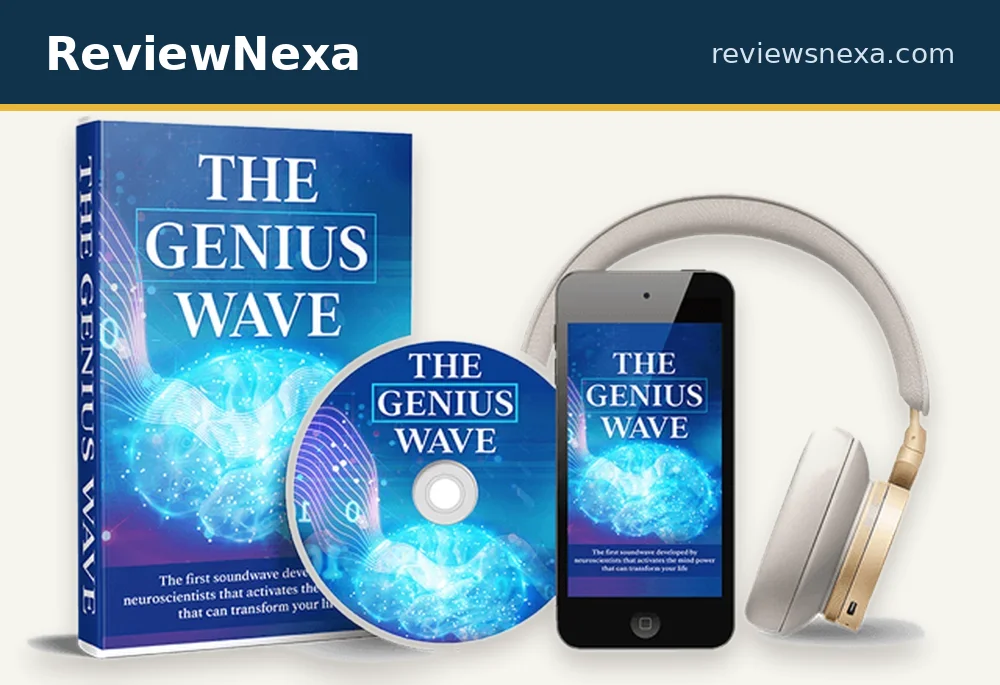
- Theta binaural audio
- $39 one-time
- 90-day guarantee stated
- Digital delivery
The Genius Wave Specifications
| Product Name | The Genius Wave |
|---|---|
| Category | Mind & Brain |
| THE DETAIL | WHAT WE FOUND |
| Product type | Digital audio program — no physical product |
| Audio format | Theta-frequency track on binaural beats plus isochronic tones |
| Session length | Sources disagree — roughly 7–12 minutes |
| Price | $39 one-time, consistently reported |
| Guarantee | 90-day money-back, as advertised |
| The big caveat | "Dr. James Rivers" can't be verified as a real person |
| PACKAGE | REPORTED PRICE |
| Pricing | Check the official website for current pricing and package options. |
| Availability | Official website only — verify at checkout. |
The Genius Wave is one of those products where both the fans and the critics are half right. It’s genuinely a real audio file — a short theta-frequency session built on binaural beats — and reviewers who sat down and listened to it describe a competent, professionally produced relaxation track. It’s also wrapped in some of the loudest marketing we’ve covered this year: a possibly fictional “neuroscientist” creator, doctored celebrity endorsements, and a checkout flow that independent reviewers warn will try to bill you for extras you never picked. This review tries to separate the file from the funnel.
The Essentials, Up Front
| THE DETAIL | WHAT WE FOUND | WHY IT MATTERS |
|---|---|---|
| Product type | Digital audio program — no physical product | Sales-page imagery hints at CDs, books, and headphones; buyers get a download. |
| Audio format | Theta-frequency track on binaural beats plus isochronic tones | Stereo headphones are required — phone speakers can’t produce the binaural effect. |
| Session length | Sources disagree — roughly 7–12 minutes | More than one version seems to be in circulation; don’t bank on a specific number. |
| Price | $39 one-time, consistently reported | The “marked down from $200” price is theater — $39 is the real price. |
| Guarantee | 90-day money-back, as advertised | Refund difficulty is a documented complaint; ClickBank’s portal, not vendor email, is the reliable route. |
| The big caveat | “Dr. James Rivers” can’t be verified as a real person | Fake endorsement ads — including doctored Elon Musk imagery — have been documented. |
What You're Actually Buying
Let’s start with the least controversial part: The Genius Wave is a downloadable audio track. You pay $39 through ClickBank, and within minutes you get access to the main theta-frequency audio file plus a bundle of bonuses. No pills, no equipment, no subscription for the core product — just files and lifetime access to them.
The track itself targets the theta brainwave band (roughly 4–8 Hz), the range researchers associate with deep relaxation, creative drift, and the edge of sleep. It does this with binaural beats — slightly different frequencies played into each ear so the brain “hears” a third tone — layered with isochronic tones. The mechanics matter for one practical reason: binaural beats only work with stereo headphones. Playing the track over phone speakers defeats the whole mechanism, and several reviewers flag this because the sales page doesn’t stress it nearly enough.
The bonus bundle reads like standard funnel padding: a wealth-focused ebook, a guided visualization audio, and a habits infographic. Multiple independent reviewers describe these as thin add-ons — one reviewer identified the wealth ebook as repackaged public-domain content — and advise against letting them influence the buying decision. Fair enough: you’re buying the audio, not the library.
One more honest wrinkle before we move on: the length of the main track. Some reviewers describe a 7-minute session, others 12 minutes. There’s no way to reconcile this from the outside, which suggests different versions of the program have circulated through the funnel. Treat the length as “short — under fifteen minutes,” and if an exact runtime matters to you, confirm it on the live offer page before paying.
Does It Actually Do Anything?
Here’s where we split the question in two, because it genuinely has two answers.
As a relaxation audio, it seems to be the real thing. The cautiously-positive independent reviewers — several of whom, full disclosure, sell the product themselves, so take their warmth with a pinch of salt — describe a well-produced track that works as a short daily reset. They report modest, gradual effects: a calmer transition into work, slightly steadier focus, a clearer head after a week or three of consistent listening. The mechanism they keep coming back to is almost embarrassingly simple: headphones on, eyes closed, a few quiet minutes — the ritual itself does most of the heavy lifting, and the entrainment audio rides along.
As a genius-maker or wealth magnet, no. Not one reviewer — positive or otherwise — reported dramatic cognitive gains, breakthrough creativity, or any change in their financial life. Every reviewer who liked the audio drew the same line: the wealth and “inner genius” claims are marketing fluff with no scientific backing. There is no published study of this specific recording; nothing about it has been evaluated the way a real claim would need to be.
What about binaural beats in general? The broader research literature suggests rhythmic audio can have a modest, real effect on relaxation and attention in lab settings — but that’s a statement about a research field, not a verdict on this $39 download, and it’s the vendor, not the science, that connects the two. If you’re buying this for a small daily calm-down ritual, the evidence says that’s the plausible best case. If you’re buying it expecting to think like a genius, you’re buying a fantasy.
KEEP IT IN PERSPECTIVE
The honest pitch for this product fits in one sentence: a short, cheap daily relaxation ritual with decent production quality. Everything beyond that sentence — the genius framing, the wealth framing, the NASA-adjacent origin story — is sales copy, not evidence.
The Marketing Problem
The audio is the easy part to evaluate. The marketing is where this product earns its caution flag — and the reviewers we read spend more words on the marketing than on the track itself.
The creator. The Genius Wave is sold as the work of “Dr. James Rivers,” an MIT- and NASA-linked neuroscientist. The problem: that name appears nowhere outside the product’s own marketing. Independent reviewers describe him as a marketing persona, not a verifiable individual, and we found no research record, affiliation, or credential to back the story up. The NASA connection, in particular, is documented as fabricated.
The ads. Fraud investigators documented fake endorsement ads for this product — including doctored imagery of Elon Musk — plus claims of media coverage that don’t check out. These ads run through affiliate networks, which means the vendor can shrug and point at “third parties,” but they exist, and they’re designed to make you trust the product for reasons that aren’t real.
The price theater. The sales page marks the program down from a “regular” price of around $200 to $39. That $200 price never existed. It’s a prop, and it’s been on the page long enough that regular buyers should just ignore it — $39 is the actual price, and it has been all along.
The testimonials. The funnel cites a five-figure user count and glowing reviews; investigators found the count fabricated and no verifiable genuine customer reviews on the open web. Combined with a Trustpilot skew toward one-star reviews, the picture is clear: the marketing machine runs far ahead of anything real users are saying.
None of this makes the audio file itself bad. It does mean you should buy it — if you buy it at all — for the audio alone, with every other claim priced at zero.
What Buyers Complain About
Now the part that actually decides whether this is a safe purchase: the checkout and refund record. The outside reviewers and buyer-feedback platforms we read agree on a pattern — and it’s not a flattering one.
Pre-checked upsells. The checkout page has pre-selected boxes for additional subscription products. Buyers who don’t notice and uncheck them report being billed for extras they never consciously chose — including small monthly charges that kept recurring. This is the single most-reported complaint, and it’s the reason every defensive-buyer guide for this product says the same thing: read every checkout screen twice before submitting payment.
Disputed charges. At least one buyer reported a charge appearing after entering payment details but before ever pressing submit — ClickBank reversed it, which is reassuring about the processor, less reassuring about the funnel. Separate from that, buyers report recurring charges they never agreed to, consistent with the pre-checked upsell pattern.
Weak vendor support. Reviewers consistently describe the seller’s own support as slow or unhelpful when refund requests go through vendor email. The consensus route for a refund is ClickBank’s own support and self-service refund portal — the independent refund channel that makes a ClickBank purchase meaningfully safer than a direct-vendor one. Keep your order confirmation, screenshots of every checkout step, and your card statement, and don’t rely on the vendor’s inbox.
The refund guarantee, in practice. The seller advertises a 90-day money-back guarantee, and that window is the stated policy. But multiple sources describe real difficulty getting refunds honored through the vendor — the guarantee is only as good as the channel you use to claim it. If you decide to try the product, know ClickBank’s refund route before you pay, not after something goes wrong.
One thing in the product’s favor: digital delivery is fast — buyers report access within minutes of purchase — and there are no shipping or physical-product complaints, because there’s no physical product. The problems all live in the billing layer, which at least means a careful eye can dodge them.
How It's Meant to Be Used
Here’s how the program tells buyers to listen, according to reviewers who went through the materials:
- Headphones, non-negotiable. Binaural beats need separate audio channels for the left and right ear. Speakers, earbuds with a shared channel, or “just playing it in the room” won’t deliver the intended effect.
- Once daily, quiet room, eyes closed. Sit or lie down; many reviewers suggest mornings, before work or a creative session, when the transition-into-focus effect is most useful.
- Never while driving or doing anything that needs full attention — the track is designed to relax you, which is exactly what you don’t want behind the wheel.
- Judge it after two to four weeks of consistent daily use, not after one session. Even the friendliest reviewers frame the effect as gradual and cumulative.
A safety note that matters: for most healthy adults this is just audio, and the worst reviewers report is occasional mild headaches or lightheadedness in the first sessions. But anyone with epilepsy or a known sensitivity to rhythmic audio should check with a clinician first and skip it if there’s any doubt. That’s not legal boilerplate — pulsing audio genuinely isn’t for every brain.
Pros and Limitations
Best for
Someone who wants a short, cheap daily relaxation ritual — and reads checkout screens carefully.
Main limitation
Unverifiable creator, fabricated marketing claims, and no evidence behind the genius or wealth framing.
Buyer risk
Pre-checked upsells and disputed charges are a documented, repeated pattern.
Pros
- a keepable short daily habit — under fifteen minutes a day
- reviewers describe the audio itself as genuinely well produced
- no supplements, no learning curve, instant digital delivery
- ClickBank processing gives you a real, independent refund channel
- $39 one-time is a small, bounded bet next to coaching or neurofeedback gadgets
Limitations
- documented checkout problems — pre-checked upsells, charges buyers didn’t finalize, recurring billing buyers never agreed to
- vendor-side refunds described as a fight; you must use ClickBank’s portal
- creator credentials unverifiable; celebrity ads and testimonial counts documented as fake
- no study of this recording exists — the genius and wealth claims have no evidence
- bonuses are thin filler; don’t let them move your decision
- anyone with epilepsy should consult a clinician first
Price and Guarantee
| PACKAGE | REPORTED PRICE | NOTES |
|---|---|---|
| Core program (main audio track + 3 bonuses) | $39 one-time | Confirm one-time billing; uncheck every pre-selected upsell box |
As reported at the time of writing — verify on the vendor’s page before you pay.
What this badge means
The badge reflects the seller-advertised 90-day refund window — not a promise of results. Buyers describe the vendor’s own support as the weak link, so exercise the guarantee through ClickBank’s support or self-service portal, which reviewers say works. Keep your order confirmation, screenshots, and card statement.
Two things worth repeating because they cost people money: first, the “$200 regular price” is a prop — $39 is the actual, standing price, so there’s no deal to hurry for. Second, the upsell boxes are pre-checked. Treat the checkout page like a contract you’re signing, because functionally it is: read every line, uncheck everything you didn’t come for, and screenshot each step so a disputed charge becomes a five-minute refund instead of a month-long fight.
Who Might Consider It — and Who Shouldn't
Consider it if you want a short, inexpensive daily wind-down ritual, you’re comfortable with a digital-only product, and you’re the kind of person who actually reads checkout screens. The $39 is a bounded, refundable experiment — as long as you buy it defensively.
Skip it if unverifiable credentials are a dealbreaker for you (for plenty of readers they should be), if you have epilepsy or sensitivity to rhythmic audio and haven’t cleared it with a clinician, or if you’re buying for the wealth and “inner genius” promises. An audio file cannot do those things, and no purchase should be priced on the hope that it can. If the marketing is what excites you rather than the audio, that’s your sign to walk away.
Questions Worth Asking Yourself First
- Ritual or fantasy? Only the short daily relaxation ritual is real. Price everything else at zero.
- Are you prepared to uncheck every pre-selected upsell and confirm one-time billing before submitting payment?
- Do you know ClickBank’s refund route — and will you use it instead of the vendor’s email if something goes wrong?
- Would this still be worth $39 to you if the only outcome is a few calmer minutes a day?
- Have you compared the calmer-pitched Brain Song alternative in the same lane?
FAQ
Is The Genius Wave a real product?
Yes. You do get a genuine audio download, and the ClickBank refund route is genuine too. What's questionable is everything wrapped around it: the unverifiable creator story, the documented fake endorsements, and the checkout problems buyers keep reporting.
Is Dr. James Rivers a real neuroscientist?
No. The MIT and NASA credentials appear only in the product's own marketing, and independent reviewers describe "Dr. James Rivers" as a marketing persona. We found no verifiable research record, affiliation, or identity behind the name.
Does it really cost $39 one-time?
Yes. $39 one-time is the consistent, real price across every independent review we read. The inflated "regular price" it's marked down from is discount theater — confirm the live total and uncheck the pre-selected extras anyway.
Is it safe to listen to?
Yes. For most healthy adults it's simply audio — the worst reviewers report is occasional early-session headaches or lightheadedness. Anyone with epilepsy or a known sensitivity to rhythmic audio should consult a clinician first and skip it if there's any doubt.
Can the user recover money from a bad checkout charge?
Yes. Act quickly: keep your order confirmation and screenshots, then go through ClickBank's support or self-service refund portal rather than the vendor's email, which reviewers describe as weak. Watch your card statement for recurring charges you never agreed to.
Is The Genius Wave a scam?
No. The Genius Wave is a real, purchasable product that ships through ClickBank, with a stated 90-day money-back guarantee backing every order. "Scam" would mean fake goods or vanished payments, and we found no evidence of that.
Does The Genius Wave have a money-back guarantee?
Yes. Every The Genius Wave order is covered by a 90-day money-back guarantee. If you're not satisfied, you can request a refund within 90 days of purchase — keep your order confirmation email as proof of purchase.
Where can I buy The Genius Wave?
Through the official website. The Genius Wave is not sold on Amazon, eBay, or in retail stores — buying from the official site is the only way to guarantee an authentic product and qualify for the money-back guarantee.
Is The Genius Wave worth buying?
Depends. The Genius Wave is worth trying if the formula matches your specific concern and you're comfortable with the price — especially with the 90-day money-back guarantee removing most of the risk. It is not worth buying if you expect overnight or guaranteed results, because no supplement can promise those.
Our Verdict: The Genius Wave
OUR VERDICT
The Genius Wave is a study in contrasts: the file is fine, the funnel is the problem. The audio itself is a decent, well-produced relaxation track, and $39 with a real ClickBank refund route is a small, bounded bet — but only for the defensive buyer who reads every checkout screen twice and screenshots everything. The genius framing, the wealth promises, the unverifiable creator, the doctored ads, and the recurring billing complaints mean most readers should either buy it for the ritual alone or not buy it at all. There are cheaper, less sketchy ways to buy yourself a few calm minutes a day; if you choose this one, go in with your eyes open.
Final Buyer Checkpoint
- ✓ Verify the live total and confirm one-time billing before paying.
- ✓ Uncheck every pre-selected upsell on the checkout page.
- ✓ Screenshot every checkout step and keep the order confirmation.
- ✓ Remember this is an audio wellness product, not a medical treatment — its claims haven’t been evaluated by the FDA.
- ✓ Anyone with epilepsy or sensitivity to rhythmic audio should consult a clinician first.
Editorial Note
We approach products like this one with a simple rule: the audio gets judged as audio, and the marketing gets judged as marketing. The first earns a cautious nod; the second earns most of the words on this page. If you decide to try it, the offer page below goes to the same ClickBank checkout independent reviewers used — read it like a contract, and keep your receipts.
Related Reviews

Testing statement: Desk research · No hands-on or clinical testing